|
 |
 |
 |
 |
 |
 |
 |
 |

 |
Space Age Still Fresh On Kazakh Steppes
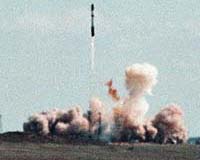
Baikonur (UPI) Jun 29, 2004 It is about the least imposing observation point to watch a space rocket launch that you could imagine - just a corrugated iron shack about 25 feet long by 10 feet deep. And the only refreshments available are bottles of water to stave off the shimmering heat of the burning summer Kazakh steppe. But once the rocket engine ignites, you don't think about that, you don't think about anything. Seven kilometers, or 4.2 miles away, black powder gas has been pumped into a concrete-lined subterranean silo. The Dnepr booster, all 210 tons of it, is pushed by the gas out of its launching container with the protection tray beneath it still attached. Then the protection tray and the sealing rings are jettisoned. Only when the huge rocket has been propelled into view above the launch silo does the first stage ignite, and there is no mistaking that. Beneath the pencil-thin black line that is the 100-foot high Dnepr rocket four miles away, a brilliant orange-red flare erupts, bright as the flames of an old Pittsburgh steel furnace, bright as the fires of hell itself. Your eyes are held by continuing glare of the fiery exhaust eruption, even as the rocket rises. All is silent. And it is still silent as the smoke clouds billow and mushroom like a World War II 20,000-pound blockbuster bomb hitting its target. Except the energies here being released far exceed that. If something went wrong, if all the volatile fuels exploded on takeoff, the effect would be akin to a small tactical nuclear weapon exploding. But no one is worried about that here. The famed Baikonur Cosmodrome now operated by Russia's Federal Space Agency doesn't stand on ceremony. There were no speeches, no welcoming parties, no parades or media extravaganzas. And the reliability rate so far of the new Dnepr booster is 97 percent. Finally, close to half a minute after the first stage rocket engines is ignited, its roar hits the observation stand. Later, Russian and Kazakhstan officials politely and with obvious embarrassment apologize that it should have been louder. I am sorry, says Nurgazev Ergazi Meirgalyevich, the special envoy of Kazakhstan President Nursultan Nazarbayev to the Baikonur Cosmodrome. Today's launch was not as impressive as a Proton or Soyuz. They are far more viewable, far more spectacular. The sound is stronger too. He needn't have apologized. A Dnepr launch may be old news to the Russian and Kazakh engineers and space scientists who have made satellite launches and space station commutes from Baikonur safe and routine - the only space port or cosmodrome in the world of which that can yet be said. But to anyone else, they are spectacular experiences to last a lifetime. The sound from Dnepr's engines roars back in and rattles the corrugated iron shed. It is not thunder, more like a thousand Main Battle Tanks revving up at the same time, or the way a Tyrannosaurus Rex must have sounded when it was clearing its throat. By now Dnepr is rising fast and for all its 210-ton bulk it does not stand on stately ceremony like an old Saturn-V of the U.S. Apollo program in the 1960s. Saturn V seemed to hover over the launch pad as if slowly making up its mind whether to head off to the Moon or just settle back on its cradle. But Dnepr takes off like a scalded cat. And as it shoots across the blazing high noon Kazakh sky, the observers dash out of the back of the still-rattling corrugated iron observation shed to keep track of it. That isn't easy. Unlike so many U.S. space launches, Dnepr doesn't leave a vapor trail. It's just a dot by now streaking across the heavens and soon we are dependent on the clipped, simple no-nonsense Russian of the radio announcer at Mission Control Baikonur to tell us what is going on. Within little more than a minute after launch, the first stage cuts off and separates, then the second stage ignites little more than two minutes from launch. Soon, that has shut down and separated too. The hard work and sweat of doing business in space takes months and years to prepare. Then it's over before you can blink. Mission Control Baikonur keeps us informed. 186 seconds. Everything OK. 190 seconds. All is normal. 200 seconds. Engine stable. 210 seconds. Rocket is stable. There's still tension in the observation platform, however. The Saudi Arabian, U.S. satellite company and European Space Agency engineers and executives present still don't know if their precious electronic cubes and footballs will go into orbit precisely where they're supposed to. Within seven minutes after launch, Dneper is 240 miles down-range and still ascending at a speed of 15,000 miles per hour. In less than 11 minutes, it's so far down-range that Baikonur's own radio monitoring stations can no longer track it. Finally, within 15 minutes of take-off, the Saudi delegation in their flowing robes and uncompromising black, formal suits are high-fiving it and shouting with delight. Mission Control Baikonur has confirmed the successful separation of all three of their sat-coms. Confirmation for the three U.S. ones and the two ESA satellites, one Italian and one French comes immediately afterwards. It's a bittersweet moment for the U.S. space executives. Their three priceless pieces of hi-tech hardware are now safely in orbit and set to operate at high profit. But with the Space Shuttle grounded for the foreseeable future and huge clouds of uncertainty hanging over NASA's future programs, it took a Russian-Ukrainian rocket to put them there. And there was none of the self-congratulatory boosterism or triumphalism that accompanies any major U.S. launch at Cape Canaveral. Baikonur takes this kind of thing in its stride. A NASA executive asked us at a launch a while ago why nobody screamed and cheered here, when another manned cosmonaut launch went up, a young Russian engineer tells United Press International. Why should we, It's just another routine job for us. All rights reserved. Copyright 2004 by United Press International. Sections of the information displayed on this page (dispatches, photographs, logos) are protected by intellectual property rights owned by United Press International. As a consequence, you may not copy, reproduce, modify, transmit, publish, display or in any way commercially exploit any of the content of this section without the prior written consent of by United Press International. Community Email This Article Comment On This Article Related Links SpaceDaily Search SpaceDaily Subscribe To SpaceDaily Express Space Tourism, Space Transport and Space Exploration News
 Spicing Up Space Meals
 Los Angeles CA (SPX) Jan 04, 2006
Since its launch a year and half ago, Minimus.biz has quickly become the place to go for individual and travel size items. Last week, NASA came to Minimus.biz and purchased several different travel size condiments to send with the astronauts to the International Space Station. |
|
|

| The content herein, unless otherwise known to be public domain, are Copyright 1995-2006 - SpaceDaily.AFP and UPI Wire Stories are copyright Agence France-Presse and United Press International. ESA PortalReports are copyright European Space Agency. All NASA sourced material is public domain. Additionalcopyrights may apply in whole or part to other bona fide parties. Advertising does not imply endorsement,agreement or approval of any opinions, statements or information provided by SpaceDaily on any Web page published or hosted by SpaceDaily. Privacy Statement |