|
 |
 |
 |
 |
 |
 |
 |
 |

 |
SpaceWatch NASA Faces Final Budget Debate
Washington DC (UPI) Sep 16, 2004 If NASA's battle over its fiscal year 2005 budget were a baseball game, it now would be in bottom of the eighth inning with score tied -- and Congress at bat. Having failed to win House of Representatives approval for funding of President Bush's ambitious plan to send astronauts back to the moon and on to Mars, NASA now faces a similar battle next week in the Senate. There, the appropriations subcommittee that reviews the budgets of the Veterans Administration, Department of Housing and Urban Development, and independent agencies -- including NASA -- likewise may not approve new funds for the Bush space plan. If this happens, and Congress fails to include the $866 million requested by the administration in its final legislation, it would effectively kill all of the new space projects the president has sought. This latest cliff-hanger was triggered last week by tight spending limits imposed on subcommittee appropriators. Shortfalls in the VA, housing and loan-guarantee budget areas have left the chairman, Sen. Christopher S. Kit Bond, R-Mo., with insufficient room to cover the needs of the agencies under his purview. NASA Administrator Sean O'Keefe once told United Press International he considered these maneuvers a political game of chicken. He may well be right about that. At stake are potential billions of dollars in development contracts for the U.S. aerospace firms that would design and manufacture the new space vehicles, equipment, robots and launching rockets for the Bush space plan. NASA already has started the countdown to release of a January 2005 request for proposals for the new moonship -- called the crew exploration vehicle or CEV -- as well as the booster rocket to lift it into space. Last week, the agency awarded some $27 million in study contracts to 11 firms -- including Boeing, Lockheed Martin, Northrop Grumman and smaller businesses and non-profits -- to start planning the lunar missions and related scientific research programs. Those funds came out of unspent money remaining in fiscal year 2004, which ends Sept. 30. If the appropriations bill actually moves to the Senate floor for a vote, it could trigger the first serious political debate about space spending since the 1989 and 1990 fights over the International Space Station. Those funding battles, which occurred under President George H.W. Bush, came within a single vote of canceling the station before the administration prevailed. What was canceled, however, was another Bush 41 space initiative -- a dream by the current president's father to send astronauts back to the moon and onward to Mars. The idea was less detailed and developed than the project proposed by the current president, and it failed to pass either house of Congress and eventually was abandoned. Regarding the latest funding effort, O'Keefe -- himself a former Senate staffer -- could forestall the budget ax if he manages to prevent the appropriations bill from receiving a vote on the Senate floor and exploiting its tightly constrained calendar. Time is running out before the pre-election congressional recess, so any unfinished business would be held over until the post-election, lame-duck Congress returns. Such a strategy would mirror what happened in the House, where members of the coinciding appropriations subcommittee killed Bush's new space exploration budget, but failed to move the corpse to the floor. Majority Leader, Rep. Tom Delay, R-Texas, has vowed to block the bill from getting to the floor if it does not contain the requested money. Further upping the ante, White House officials have let it be known the president would veto any space spending bill that excluded funds for his new project. O'Keefe reminded senators on the appropriations subcommittee of this fact last week. O'Keefe also might have one more budget trick up his sleeve: If either the House or the Senate fails to approve a separate space appropriations bill, he might urge NASA's supporters in Congress to attempt to link it with other, uncompleted spending measures in a so-called omnibus bill. It might even be possible, under this strategy, to add more funds in the House-Senate conference than either side had approved separately. The move would be tricky, however, and it could be quite costly for O'Keefe in terms of political capital. Additional budget complications have arisen since Bush announced the new space effort last January. For example, the costs of returning the space shuttle fleet to flight have risen substantially -- they now exceed $1 billion. The original projections had placed shuttle repair costs at less than half that amount. Also, an unplanned, robotic rescue of the Hubble Space Telescope is likely to cost more than $1.6 billion, portions of which would need to be funded in FY 2005 so planning for the mission -- assuming it is approved -- can begin. Last, and most unpredictable, Hurricane Frances caused damage to the shuttle launching facilities at Cape Canaveral, Fla., and added millions of dollars to NASA's needs. What might lie ahead for NASA in its effort to win approval of the space exploration plan? Those familiar with the agency's strategy told UPI that officials remain hopeful the Senate Appropriations Committee will OK the requested funds. Even if the request is trimmed, however, NASA still has the omnibus bill and the resulting conference committee compromise as its final, ninth inning play. Community Email This Article Comment On This Article Related Links SpaceDaily Search SpaceDaily Subscribe To SpaceDaily Express Space Tourism, Space Transport and Space Exploration News
 NASA Refines Design For Crew Exploration Vehicle
 Washington DC (SPX) Jan 12, 2006
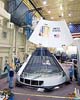
NASA's Constellation Program is making progress toward selecting a prime contractor to design, develop and build the Crew Exploration Vehicle (CEV), America's first new human spacecraft in 30 years. |
|
|

| The content herein, unless otherwise known to be public domain, are Copyright 1995-2006 - SpaceDaily.AFP and UPI Wire Stories are copyright Agence France-Presse and United Press International. ESA PortalReports are copyright European Space Agency. All NASA sourced material is public domain. Additionalcopyrights may apply in whole or part to other bona fide parties. Advertising does not imply endorsement,agreement or approval of any opinions, statements or information provided by SpaceDaily on any Web page published or hosted by SpaceDaily. Privacy Statement |