|
 |
 |
 |
 |
 |
 |
 |
 |

 |
Southwestern Drought Like Recent One Has Recurred During Past Millennium
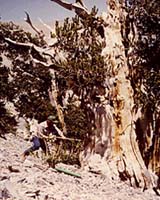
Tucson - May 13, 2003 Drought as striking as the recent drought in Arizona and New Mexico is unusual but not unknown, conclude tree-ring scientists who have reconstructed a thousand-year history of winter precipitation in the American Southwest. Moreover, both states have gone through longer, drier spells, they add. Scientists at the University of Arizona Laboratory of Tree-Ring Research (LTRR) used two different methods to rigorously analyze a consolidated set of 19 long-lived western tree chronologies built over decades. The thousand-year record shows several sustained dry periods comparable to the 1950s drought in both Arizona and New Mexico. These include droughts in the late 1000s, the mid 1100s drought that coincides with the end of Anasazi occupation of Chaco Canyon in northwestern New Mexico, the 1570-97 megadrought, and droughts of 1664-70, the 1740s, the 1770s, and the late 1800s. "The message is that the recent drought is not so very unusual. There have been worse in some parts of the Southwest. And without speculating on the future, you have to say that what has happened can happen again," said Malcolm K. Hughes of the LTRR, whose work to reconstruct past climate from tree rings is funded under the National Oceanic and Atmospheric Administration's (NOAA) Paleoclimatology program. Similarly, the record shows wet periods followed the several sustained dry periods. They were comparable to the wet conditions recorded by weather instruments in the early 1900s and after 1976. The most persistent and extreme of these occurred in the late 1330s and in 1915. The conventional practice of basing policy or planning public works according to a 30-year climate average is a dubious one, given that the previous three decades may be unusually wet or dry, with climate on the cusp of change, Hughes said. Planners need a longer perspective on climate, and greater understanding of how climate varies within different divisions of Arizona and New Mexico, he said. LTRR scientists have been collecting samples of long-lived species of pine, fir, juniper and sequoia from forests in Arizona, California, Utah, New Mexico, Colorado, and elsewhere for a century. They have pieced together long records, or chronologies, of climate, fire and other natural history by matching annual ring-width patterns. Thanks to the water-sensitive, long-lived trees, "We can more easily get a good picture of centuries-long climate change in this region than almost anywhere else on Earth," Hughes said. This study reconstructed November-through-April precipitation in each of seven climate divisions in Arizona and eight climate divisions in New Mexico. The LTRR's Fenbiao Ni and Tereza Cavazos, then of the UA geography department, were lead authors of a paper on the results recently published in the International Journal of Climatology. The work was funded by NOAA's Office of Global Programs through the UA's Climate Assessment for the Southwest, or CLIMAS, project. CLIMAS aims to make research results on this region's climate more publicly accessible for government, industry, agriculture, natural resource management, and others who need it. The scientists carefully selected 19 of 76 chronologies of 1,000 years or longer to get the best information on long-term climate change, or climate change that occurs over several centuries of time, in the U.S. Southwest. Every piece of wood in the many pieces of wood in each chronology contained at least 500 annual growth rings, and more typically 700 growth rings. "A dry year like 2002 is a recurrent part of life in this region," said Kurt Kipfmueller of the Tree-Ring Lab and CLIMAS, referring particularly to the southern and southeastern region in Arizona. "It's not outside the envelope of the past 1,000 years. There may be two or three or four years like this a century." While 2002 was a dry year throughout most of western New Mexico, Kipfmueller noted, "still, some places were somewhat wet. It isn't nearly so unusually dry in New Mexico as it is in Arizona. Not only that, but 2001 is actually a break in the drought, and that's a point that's been hard to get across. From a 4-year perspective, the past four years in Arizona have clearly been dry, but it's not all that anomalous with respect to the last 1,000 or even 100 years." Hughes and Kipfmueller said that several consecutive years of less-than-normal precipitation can be tougher on water users in the region than a couple of years of dramatically decreased annual rainfall. The cumulative water deficit problem is the real issue for water users, they said, particularly in Arizona because of its booming population. Community Email This Article Comment On This Article Related Links Laboratory of Tree-Ring Research at UoA SpaceDaily Search SpaceDaily Subscribe To SpaceDaily Express Dirt, rocks and all the stuff we stand on firmly
 Magnetic Reconnection Region Larger Than 2.5 Million Km Found In The Solar Wind
 Paris (ESA) Jan 12, 2006
Using the ESA Cluster spacecraft and the NASA Wind and ACE satellites, a team of American and European scientists have discovered the largest jets of particles created between the Earth and the Sun by magnetic reconnection. This result makes the cover of this week's issue of Nature. |
|
|

| The content herein, unless otherwise known to be public domain, are Copyright 1995-2006 - SpaceDaily.AFP and UPI Wire Stories are copyright Agence France-Presse and United Press International. ESA PortalReports are copyright European Space Agency. All NASA sourced material is public domain. Additionalcopyrights may apply in whole or part to other bona fide parties. Advertising does not imply endorsement,agreement or approval of any opinions, statements or information provided by SpaceDaily on any Web page published or hosted by SpaceDaily. Privacy Statement |