
 |
 |
 |
 |
 |
 |
 |
 |
 |

 |
Southern Ocean Seals Dive Deep For Climate Data
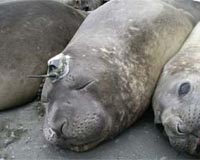
Canberra, Australia (SPX) Aug 13, 2008 According to a paper published by a team of French, Australian, US and British scientists in the Proceedings of the National Academy of Sciences, elephant seals fitted with special oceanographic sensors are providing a 30-fold increase in data recorded in parts of the Southern Ocean rarely observed using traditional ocean monitoring techniques. "They have made it possible for us to observe large areas of the ocean under the sea ice in winter for the first time," says co-author Dr Steve Rintoul from the Antarctic Climate and Ecosystem Cooperative Research Centre (ACE CRC) and CSIRO's Wealth from Oceans National Research Flagship. "Conventional oceanographic platforms cannot provide observations under the sea ice, particularly on the Antarctic continental shelf where the most important water mass transformations take place. Until now, our ability to represent the high-latitude oceans and sea ice in oceanographic and climate models has suffered as a result." Co-author, University of Tasmania Professor Mark Hindell says the seal data complements traditional oceanographic sampling from ships, satellites and drifting buoys. "By providing ocean measurements under the sea ice, the seals are helping us to establish the global ocean observing system we need to detect and understand changes in the ocean," he says. The polar regions play an important role in the earth's climate system and are changing more rapidly than any other part of the world. In the southern hemisphere, the limited observations available suggest that the circumpolar Southern Ocean has warmed more rapidly than the global ocean average and that the dense water formed near Antarctica and exported to lower latitudes has freshened in some locations and warmed in others. Polar changes are important because a number of feedbacks involving ocean currents, sea ice and the carbon cycle have the potential to accelerate the rate of change. The seals typically covered a distance of 35-65 kilometres a day with a total of 16,500 profiles obtained in 2004-5. Of these, 8,200 were obtained south of 60S, nine times more than have been obtained from floats and research and supply ships. The 4,520 profiles obtained within the sea ice is a 30-fold increase over conventional data. The seals dived repeatedly to a depth of more than 500 metres on average and to a maximum depth of nearly 2000m. The Australian team included scientists from CSIRO, the ACE CRC, the University of Tasmania's School of Zoology and Centre for Marine Science and Charles Darwin University. Community Email This Article Comment On This Article Share This Article With Planet Earth
Related Links Centre for Australian Weather and Climate Research (CAWCR) Climate Science News - Modeling, Mitigation Adaptation
 Climate Change May Be Pushing Birds Move Farther North
 Syracuse NY (SPX) Aug 12, 2008
A study by researchers at the SUNY College of Environmental Science and Forestry (ESF) has documented, for the first time in the northeastern United States, that a variety of bird species are extending their breeding ranges to the north, a pattern that adds to concerns about climate change. |
|
|

| The content herein, unless otherwise known to be public domain, are Copyright 1995-2007 - SpaceDaily.AFP and UPI Wire Stories are copyright Agence France-Presse and United Press International. ESA Portal Reports are copyright European Space Agency. All NASA sourced material is public domain. Additional copyrights may apply in whole or part to other bona fide parties. Advertising does not imply endorsement,agreement or approval of any opinions, statements or information provided by SpaceDaily on any Web page published or hosted by SpaceDaily. Privacy Statement |
 del.icio.us
 Digg
Digg Reddit
 YahooMyWeb
 Google
 Facebook