|
 |
 |
 |
 |
 |
 |
 |
 |

 |
South Korea To Develop High-Altitude Interceptor Missile
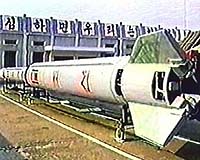
Seoul (AFP) April 10, 2007 South Korea will develop high-altitude interceptor missiles to cope with North Korea's ballistic missiles, the head of a state-run defence research agency said Tuesday. Ahn Dong-Mahn, head of the Agency for Defence Development (ADD), also said South Korea had joined the international race to develop electromagnetic E-bombs capable of disabling enemy computers and radio or radar receivers. In an interview with the Korea Defence Daily, Ahn said the agency and 16 other defence companies planned to develop a medium-range ground-to-air missile, known as Iron Hawk-II, by 2011. "We will add modifications to Iron Hawk-II to produce interceptor missiles against guided missiles," Ahn was quoted as saying. North Korea has deployed short-range Scuds and Rodongs with a range of 1,300 kilometres (780 miles), while actively developing longer-range Taepodong missiles that theoretically could reach parts of the United States. It launched a Taepodong over Japan in 1998, sparking a major security alert. Ahn also said the ADD planned to develop electromagnetic pulse (EMP) and high power microwave (HPM) bombs by 2015. "We have drawn up a roadmap to develop EMP and HPM technology into future precision-strike weapons," Ahn said, adding other advanced countries have been secretly developing this technology. EMP and HPM technology has matured to the point where practical E-bombs are becoming technically feasible, experts say. The EMP effect, first observed during the early testing of high altitude airburst nuclear weapons, is characterised by the production of a strong electromagnetic shock wave that inflicts irreversible damage on electrical and electronic equipment. HPM bombs fry any electronic equipment within their impact area such as computers and radar, leaving the enemy defenceless.
Source: Agence France-Presse Community Email This Article Comment On This Article Related Links Learn about missile defense at SpaceWar.com Learn about missile defense at SpaceWar.com Learn about nuclear weapons doctrine and defense at SpaceWar.com All about missiles at SpaceWar.com Learn about the Superpowers of the 21st Century at SpaceWar.com
 US BMD Case Cuts No Ice
 Moscow (RIA Novosti) April 10, 2007
Russian military experts are perplexed by the arguments which the U.S. political and military top brass are using to justify their decision to deploy forward-based missile defense elements in Eastern Europe. |
|
|

| The content herein, unless otherwise known to be public domain, are Copyright 1995-2006 - SpaceDaily.AFP and UPI Wire Stories are copyright Agence France-Presse and United Press International. ESA PortalReports are copyright European Space Agency. All NASA sourced material is public domain. Additionalcopyrights may apply in whole or part to other bona fide parties. Advertising does not imply endorsement,agreement or approval of any opinions, statements or information provided by SpaceDaily on any Web page published or hosted by SpaceDaily. Privacy Statement |