|
 |
 |
 |
 |
 |
 |
 |
 |

 |
South American Glaciers Melting Faster, Changing Sea Level
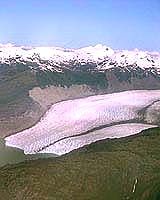
Santiago - Oct 17, 2003 The Patagonia Icefields of Chile and Argentina, the largest non-Antarctic ice masses in the Southern Hemisphere, are thinning at an accelerating pace and now account for nearly 10 percent of global sea-level change from mountain glaciers, according to a new study by NASA and Chile's Centro de Estudios Cientificos. Researchers Dr. Eric Rignot of NASA's Jet Propulsion Laboratory, Pasadena, Calif.; Andres Rivera of Universidad de Chile, Santiago, Chile; and Dr. Gino Casassa of Centro de Estudios Cientificos, Valdivia, Chile, compared conventional topographic data from the 1970s and 1990s with data from NASA's Shuttle Radar Topography Mission, flown in February 2000. Their objective was to measure changes over time in the volumes of the 63 largest glaciers in the region. Results of the study, published this week in the journal Science, conclude the Patagonia Icefields lost ice at a rate equivalent to a sea level rise of 0.04 millimeters (0.0016 inches) per year during the period 1975 through 2000. This is equal to nine percent of the total annual global sea-level rise from mountain glaciers, according to the 2001 Intergovernmental Panel on Climate Change Scientific Assessment. From 1995 through 2000, however, that rate of ice loss from the icefields more than doubled, to an equivalent sea level rise of 0.1 millimeters (0.004 inches) per year. In comparison, Alaska's glaciers, which cover an area five times larger, account for about 30 percent of total annual global sea-level rise from mountain glaciers. So what's causing the increased Patagonia thinning? Rignot and his colleagues concluded the answer is climate change, as evidenced by increased air temperatures and decreased precipitation over time. Still, those factors alone are not sufficient to explain the rapid thinning. The rest of the story appears to lie primarily in the unique dynamic response of the region's glaciers to climate change. "The Patagonia Icefields are dominated by so-called 'calving' glaciers," Rignot said. "Such glaciers spawn icebergs into the ocean or lakes and have different dynamics from glaciers that end on land and melt at their front ends. Calving glaciers are more sensitive to climate change once pushed out of equilibrium, and make this region the fastest area of glacial retreat on Earth." Rignot said the study underscores NASA's unique contributions to understanding changes in Earth's cryosphere. "From the unique vantage point of space, the Shuttle Radar Topography Mission provided the first complete topographic coverage of the Patagonia Icefields," he explained. "Researchers can now access data on this remote Earth region in its totality, allowing them to draw conclusions about the whole system, rather than just focusing on changes on a few glaciers studied from the ground or by aircraft." Rignot said scientists are particularly interested in studying how climate interacts with glaciers because it may be a good barometer of how the large ice sheets of Greenland and Antarctica will respond to future climate change. "We know the Antarctic peninsula has been warming for the past four decades, with ice shelves disappearing rapidly and glaciers behind them speeding up and raising sea level," he noted. "Our Patagonia research is providing unique insights into how these larger ice masses may evolve over time in a warmer climate," he said. The Northern Patagonia Icefield in Chile and the Southern Patagonia Icefield in Chile and Argentina, cover 13,000 and 4,200 square kilometers (5,019 and 1,622 square miles), respectively. The region, spanning the Andes mountain range, is sparsely inhabited, with rough terrain and poor weather, restricting ground access by scientists. Precipitation in the region ranges from 2 to 11 meters (6.6 to 36 feet) of water equivalent per year, a snow equivalent of up to 30 meters (98.4 feet) a year. The icefields discharge ice and meltwater to the ocean on the west side and to lakes on the east side, via rapidly flowing glaciers. The fronts of most of these glaciers have been retreating over the past half- century or more. The study benefited from ground experiments led jointly by Centro de Estudios Cientificos; Universidad de Chile; University of Washington, Seattle; and University of Alaska, Fairbanks, with funding by NASA, Fondecyt (Chilean National Science Foundation) and the National Science Foundation International Program. Community Email This Article Comment On This Article Related Links View animation: Thinning of Jorge Montt Glacier RealPlayer) Shuttle Radar Topography Mission SpaceDaily Search SpaceDaily Subscribe To SpaceDaily Express Dirt, rocks and all the stuff we stand on firmly
 Magnetic Reconnection Region Larger Than 2.5 Million Km Found In The Solar Wind
 Paris (ESA) Jan 12, 2006
Using the ESA Cluster spacecraft and the NASA Wind and ACE satellites, a team of American and European scientists have discovered the largest jets of particles created between the Earth and the Sun by magnetic reconnection. This result makes the cover of this week's issue of Nature. |
|
|

| The content herein, unless otherwise known to be public domain, are Copyright 1995-2006 - SpaceDaily.AFP and UPI Wire Stories are copyright Agence France-Presse and United Press International. ESA PortalReports are copyright European Space Agency. All NASA sourced material is public domain. Additionalcopyrights may apply in whole or part to other bona fide parties. Advertising does not imply endorsement,agreement or approval of any opinions, statements or information provided by SpaceDaily on any Web page published or hosted by SpaceDaily. Privacy Statement |