|
 |
 |
 |
 |
 |
 |
 |
 |

 |
Sorting Carbon Nanotubes Help Advance Nano-Electronics Applications
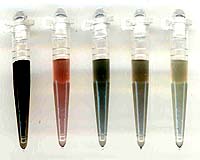
Wilmington - Dec 03, 2003 A collaborative group of DuPont-led scientists have discovered an innovative way to advance electronics applications through the use of DNA that sorts carbon nanotubes. This research in the emerging field of nanotechnology appears in the current issue of the journal Science, which is published by the AAAS � the world's largest general scientific organization. The research paper is titled "Structure-Based Carbon Nanotube Sorting by Sequence-Dependent DNA Assembly." Carbon nanotubes possess excellent electrical properties that make them potential building blocks in a broad range of nanotechnology-related electronic applications, including highly sensitive medical diagnostic devices and mini-transistors more than 100 times tinier than those found in today's microchips. When they are fabricated, however, carbon nanotubes of different electronic types randomly clump together, deterring consistent conductivity. The ability to sort and assemble carbon nanotubes allows for uniform conductivity � enabling the applications to be realized. Initially, DuPont Central Research & Development scientists found that single-stranded DNA strongly interacts with carbon nanotubes to form a stable DNA-carbon nanotube hybrid that effectively disperses carbon nanotubes in an aqueous solution. As a follow-up to that initial work, a multidisciplinary team of scientists from DuPont, the Massachusetts Institute for Technology (MIT) and the University of Illinois worked together to discover a new method for separating carbon nanotubes using single stranded DNA and anion-exchange chromatography. By screening a library of oligonucleotides, the team found that a particular sequence of single stranded DNA self-assembles into a helical structure around individual carbon nanotubes. Since carbon nanotube-DNA hybrids have different electrostatic properties that depend on the nanotubes' diameter and electronic properties, they can be separated and sorted using anion exchange chromatography. The technique can be used to separate metallic carbon nanotubes from semiconducting carbon nanotubes, both which are created during nanotube production. The technique also can sort semiconducting carbon nanotubes by diameters, an important element in nanoelectronic applications. The collaborative work is further detailed in the current edition of Science. "Wrapping of carbon nanotubes by single-stranded DNA was found to be sequence-dependent," said DuPont Central Research & Development scientist Ming Zheng. "This outstanding collaborative effort is a good example how researchers from both industry and academic institutions can work together in a multidisciplinary approach to further advance this emerging technology." DuPont Central Research & Development scientists who contributed to the research were Ming Zheng, Anand Jagota, Bruce A. Diner, Robert S. McLean, G. Bibiana Onoa, Ellen D. Semke and Dennis J. Walls. University of Illinois contributors were Michael S. Strano, Paul Barone, and Monica Usrey. MIT contributors were Adelina P. Santos, Grace Chou, Mildred S. Dresselhaus, and Georgii G. Samsonidze. Community Email This Article Comment On This Article Related Links SpaceDaily Search SpaceDaily Subscribe To SpaceDaily Express Nano Technology News From SpaceMart.com Computer Chip Architecture, Technology and Manufacture
 Water, Water Everywhere Nano
 New York (UPI) Mar 18, 2005
One of the single biggest applications of nanotechnology could be solving the global shortage of pure water, experts told UPI's Nano World. |
|
|

| The content herein, unless otherwise known to be public domain, are Copyright 1995-2006 - SpaceDaily.AFP and UPI Wire Stories are copyright Agence France-Presse and United Press International. ESA PortalReports are copyright European Space Agency. All NASA sourced material is public domain. Additionalcopyrights may apply in whole or part to other bona fide parties. Advertising does not imply endorsement,agreement or approval of any opinions, statements or information provided by SpaceDaily on any Web page published or hosted by SpaceDaily. Privacy Statement |