|
 |
 |
 |
 |
 |
 |
 |
 |

 |
Soon In Japan, It'll Be Raining Ads
Yokosuka, Japan (AFP) July 24, 2005 After being bombarded by commercials on the way to work and watching promotions pop up on the Internet, the Japanese consumer could soon be hit by advertisements where they least expect it: on their hands. Researchers are working on "information rain", taking advertisements to the realm of mock meteorology. A projector on a tall tripod shows images of raindrops hitting the ground and making ripples, in hopes that people will enter the "rainy" area and hold out their palms. A camera tracks the entrants' movements and sends the data to connected computers. Then the projector shoots out a round-shaped advertisement -- which can post words such as "SALE" -- right onto their hands. NTT Cyber Solution Laboratories, run by telecom giant Nippon Telegraph and Telephone (NTT) in the port city of Yokosuka south of Tokyo, believes the "rain" can be a perfect draw for customers. "It's quite natural that you hold out your palm when it starts raining," said Yoko Ishii, a chief researcher in the human interaction project. "People jot things down on their palms. The palm is the information tool closest to humans," she said. Much as the Internet gave way to unique pop-up and interactive advertisements, the new technology can develop in its own fashion to find ways to make the hand ads more attractive, she said. "Advertisements are usually something that's given to you, but it would be different if they showed up on your palms. You would feel more familiar with the message that appears in your personal area," she said. An advertisement on the body would help convince people that the message is really meant for them, she said. The "rain" can also be put to use to guide customers to specific stores. The direction of the projected image can change in tandem with how the person moves, meaning he or she can always get the message in the right angle. The system can also be equipped to show motion pictures, Ishii said. "This may also be able to be used during the wait at amusement parks in the future," letting people in long queues enjoy animations or movies on their palms as they move ahead, she said. Ishii said the team wanted to put the system to practical use in several years. One of the problems yet to be solved is how to make the message last longer than the rain. Ishii said researchers were looking for ways to let people bring back the information on their palms if they so choose. It is already common for Japanese mobile telephone users to take snapshots of special tiny images on print advertisements that guide them to Internet sites offering more detailed information. Dentsu, Japan's largest advertising agency, estimates that the nation's advertising market was worth 5.85 trillion yen (53 billion dollars) last year. And the industry is continually getting more high-tech. A recent study by Dentsu Communication Institute, an affiliate of the ad agency, said the Internet would take over from radio in 2007 as a bigger advertising medium, although it would still remain behind television and newspaper ads. CommunityEmail This Article Comment On This Article Related Links SpaceDaily Search SpaceDaily Subscribe To SpaceDaily Express Space Technology News - Applications and Research
 Industry Team Achieve New Communications Technology With AESA Radars
 Baltimore MD (SPX) Jan 12, 2006
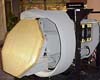
A team comprised of three leading US aerospace and defense contractors has demonstrated an innovative technological use of active electronically scanned array (AESA) radars for high-bandwidth communications. |
|
|

| The content herein, unless otherwise known to be public domain, are Copyright 1995-2006 - SpaceDaily.AFP and UPI Wire Stories are copyright Agence France-Presse and United Press International. ESA PortalReports are copyright European Space Agency. All NASA sourced material is public domain. Additionalcopyrights may apply in whole or part to other bona fide parties. Advertising does not imply endorsement,agreement or approval of any opinions, statements or information provided by SpaceDaily on any Web page published or hosted by SpaceDaily. Privacy Statement |