|
 |
 |
 |
 |
 |
 |
 |
 |

 |
Son Of shuttle
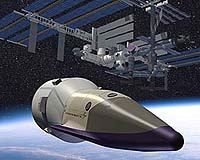
Cape Canaveral (UPI) May 10, 2005 No sooner did NASA's deadline pass for companies to submit proposals for a new passenger space transit system than the agency changed the ground rules -- a move that not only will challenge project bidders to accelerate development plans, but also opens the door for a partnership of eclectic space entrepreneurs to demonstrate if it has the moxie to fly people in space. One member of the commercial space clan actually already has done so, designing, building and flying a sub-orbital spacecraft three times last year in a successful quest for a $10 million cash prize. To garner National Aeronautics and Space Administration support for its program, however, aircraft designer Burt Rutan, creator of the first privately built passenger spaceship, will have to aim higher. Rutan's firm, Scaled Composites of Mojave, Calif., is partnered with a diverse team of former X Prize contenders, business people, researchers, technical gurus and even a former astronaut to take a stab at designing part of a space transportation system to replace NASA's space shuttles. Although the agency has a long list of new vehicles that never went farther than the drawing boards, this time around the stakes cannot be higher. NASA plans to retire its shuttle fleet by 2010. The agency hopes to have the International Space Station completed by then, but even in the best-case scenario, NASA still will need to ferry crews and supplies to the outpost after the shuttles are decommissioned. If a new vehicle fails to make if off the launch pad, the United States will be out of the human spaceflight business, at least as far as the government goes, dependent on the Russians, perhaps the Chinese, or other entities that build and fly operational space vehicles. The space station is only the first stop for the new fleet, called the Crew Exploration Vehicle or CEV. The name is something of a misnomer, as NASA plans to incorporate several technologies into its next-generation space transit system. "The idea is that we'll have other vehicles to get us from space to the surface of the moon and Mars and back again. We're not talking Buck Rogers here with one vehicle that can do it all," NASA spokesman Michael Braukus said in an interview. In addition to flying people from Earth to space, the CEV as currently envisioned also includes a travel system to the moon, a lander to touch down on the lunar surface and take off again, and future systems to take people to Mars. NASA initially planned to select two teams from among the proposals submitted last week and award contracts of an unspecified amount for both to begin design work in August or September. Then in 2008, the agency would choose one contractor to actually build the vehicle, with the first flight with people aboard scheduled for 2014. NASA's new administrator, Michael Griffin, found this scenario unacceptable and put the agency on notice he intended to shorten or eliminate the four-year transition time between shuttle and CEV. Late last week, NASA notified Congress it intends to choose a single contractor to build the CEV early next year. The intention is to have the vehicle ready for service as early as 2010, when the shuttle stops flying. While aerospace prime contractors Lockheed Martin and a partnership of Northrop Grumman and Boeing are eyeing the lion's share of CEV work, a consortium of entrepreneurs, which includes Rutan's Scaled Composites, is offering to build and operate a complementary system. The team, headed by Reston, Va.-based Transformational Space Corp., or t/Space, claims its Earth-to-orbit transit system can be ready to fly by 2008. The company, which already has received $6 million for study contracts from NASA, wants $400 million more to build what it calls the Crew Transfer Vehicle, which would travel only to and from low-Earth orbit. The bigger companies would take on the role of flying people from low-Earth orbit to the moon aboard a reusable CEV that would stay in space, according to t/Space's newly hired vice president of government relations, Brett Alexander, a former White House official in the Science and Technology Policy office. The plan would free the primes from having to design a craft that could withstand re-entry to Earth's atmosphere. NASA also would not have to go through the time and expense to modify and certify that the country's two existing expendable heavy-lift rockets are safe enough to launch people. Rutan's company would build the four-person capsule, which would be mounted on top of a booster rocket and air-launched after being dropped from a jet carrier. Upon release, the capsule's rocket motor would fire, propelling the craft to space. Rutan used a similar system for SpaceShipOne, the first privately built spaceship, which last year won the Ansari X Prize for two sub-orbital flights within less than a week. Though only a single pilot was aboard for both flights, the ship carried the equivalent weight of two more passengers. Upon return, the capsule would splash down in the water, which is how NASA landed all its vehicles prior to the shuttle. Unlike the Mercury, Gemini and Apollo capsules, however, the new capsule would be reusable. The capsule's booster would be a beefed up version of a vehicle being developed by Nevada-based AirLaunch for the military's Falcon program, which is intended to demonstrate quick and inexpensive small launch systems. In addition to Scaled Composites and AirLaunch, t/Space partners include: Constellation Services Inc. of Woodland Hills, Calif.; noted mathematician and aerospace engineer Edward Belbruno, with Princeton University; former astronaut James Voss; robotics expert Red Whittaker, with Carnegie Mellon University; Universal Space Lines of Newport Beach, Calif.; Delta Velocity Corp. of Purcellville, Va., and Spaceport Associates of Washington, D.C. NASA has $753 million in its budget to spend on the CEV program through Sept. 30, 2006. Space Race 2 is a weekly series by UPI exploring the people, passions and business of commercial human spaceflight written by long-time aerospace journalist Irene Klotz. Community Email This Article Comment On This Article Related Links SpaceDaily Search SpaceDaily Subscribe To SpaceDaily Express Space Tourism, Space Transport and Space Exploration News
 Spicing Up Space Meals
 Los Angeles CA (SPX) Jan 04, 2006
Since its launch a year and half ago, Minimus.biz has quickly become the place to go for individual and travel size items. Last week, NASA came to Minimus.biz and purchased several different travel size condiments to send with the astronauts to the International Space Station. |
|
|

| The content herein, unless otherwise known to be public domain, are Copyright 1995-2006 - SpaceDaily.AFP and UPI Wire Stories are copyright Agence France-Presse and United Press International. ESA PortalReports are copyright European Space Agency. All NASA sourced material is public domain. Additionalcopyrights may apply in whole or part to other bona fide parties. Advertising does not imply endorsement,agreement or approval of any opinions, statements or information provided by SpaceDaily on any Web page published or hosted by SpaceDaily. Privacy Statement |