|
 |
 |
 |
 |
 |
 |
 |
 |

 |
Solving The Iran Crisis Russian Style
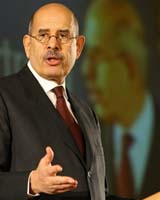
UPI Outside View Commentator Moscow (UPI) May 16, 2006 It is important to keep in mind several facts when analyzing the debates on the Iranian nuclear file in the United Nations Security Council on May 9. To start with, on April 28 the International Atomic Energy Agency, the UN's nuclear watchdog, presented a new report on the Iranian nuclear program. IAEA Director General Mohamed ElBaradei reported on some additional Iranian explanations. He also said that some of his previous concerns and suspicions had not been allayed. Moreover, the IAEA has not yet analyzed some of Iran's replies. The main news so far is that the Iranians are successfully carrying out a pilot uranium-enrichment project, just as they have declared. As of May 1, enrichment reached 4.8 percent. By so doing, they are displaying total disregard for the wishes of the world community. Tehran has irritated even those who were eager to help it avoid the dangerous confrontation. But these were merely "wishes." Under the Nonproliferation Treaty, Iran has the right to enrich uranium for peaceful purposes, while readiness to implement voluntary confidence-building measures is not a legal commitment, and their duration cannot be indefinite. As usual, the IAEA report displayed the unparalleled skills of UN bureaucrats to quote enough arguments to substantiate any position. But the conclusion is obvious -- there is no definite evidence of Iran's military nuclear program, and, hence, no reason to submit a resolution on sanctions to the Security Council. As before, its five permanent members are not unanimous on settling the situation. In his report ElBaradei used a politically correct term "suspension of all enrichment." This is what the European Union Three, or EU3 of Britain, france and Germany suggested in its initial compromise proposal, which was logical and left much room for maneuver at the talks. But once U.S. Secretary of State Condoleezza Rice came into play, this potential carrot disappeared from the EU3 proposal, and was replaced with the term "cessation." In effect, this has frustrated EU3 mediation. Moreover, it seems that neither the United States, nor Iran were too unhappy about this failure. Many analysts believe that for all the public statements of U.S. high-rankers, by and large Washington was neither interested in the success of the Moscow proposal to set up for Iran a joint uranium-enrichment center on Russian territory. Iran's contradictory and dubious attitude to this proposal shows that it has its own plans on settling the situation around its nuclear program. We know little about decision-makers in Tehran -- merely that they belong to a very narrow circle of the ruling elite, the dowreh. But it is abundantly clear that many of them are convinced that U.S. help is indispensable for a comprehensive solution, also involving bilateral relations. Apparently, the recent unexpected U.S.-Indian nuclear deal has made a great impression on the Iranian top leaders and convinced them that in principle it is possible to strike a deal with President George W. Bush without go-betweens. This is exactly what Washington wants to achieve tacitly. It does not want to allow other countries, even its NATO allies, not to mention the reviving Russia, to take part in solving any major geopolitical problems, particularly when it comes to a former strategic ally and key player on the oil market. This explains the obvious deadlock of the problem. The clandestine forces are subverting the visible negotiating process. Part Two We see two real scenarios of settling the Iranian nuclear problem problem. In principle, they are both peaceful although it is not possible to rule out altogether the use of force or asymmetrical response. But this would be a third scenario -- a disaster for the Iranians and Gulf and Mideastern Arabs that would bring disgrace upon all of its initiators. Under the first scenario, the United Nations Security Council could issue a resolution, which would sound as a warning to Iran. It should not contain any threat of force envisaged by Chapter 7 of the UN Charter. The United States and other Western countries have set forth a Chapter 7 draft resolution on implementing large-scale economic sanctions, which Washington has been carrying out without much success for several decades now. But the draft has been compiled in such a way that it is easy to delete all the "extras," or amend it in general. The authors knew beforehand that after Iraq they were not going to receive international permission for the use of force or for far-reaching sanctions. But a modified Security Council resolution, if adopted, will be no more than yet another step to the settlement of the Iranian nuclear problem. The International Atomic Energy Authority should remain the main instrument for exploring the history and real goals of the Iranian nuclear program. It should be given much more time for preparing detailed reports on the matter because the practice of monthly reports does not allow it to conduct thorough inspections and collect the information required for subsequent analysis. Resumption by Tehran of a temporary moratorium on uranium enrichment and implementation of the additional protocol requirements would be a litmus test of Iran's attitude to the opinion of the world community, expressed in the UN would-be warning resolution. But the protocol is not a cure-all and the world community should continue exploring ways for toughening control over dubious nuclear programs on an agreed-upon basis. Of course, the impatient Pentagon guys and the U.S. "hawk" in the Security Council -- U.S. Ambassador to the Untied Nations John Bolton -- would be displeased, but the world community should have a more responsible attitude to the issue of war and peace than the extremists from among the U.S. ruling elite, who are pursuing their narrow self-centered objectives. Iran also has sensible political forces -- not just President Mahmoud Ahmadinejad, who is in a sense a mirror image of his overseas critics. Paradoxical as it may seem, but now that the United States has moved the case to the United Nations in New York and almost regained its chief designer position in construing a compromise, we can expect more action in the behind-the-scenes bilateral conspiracy. The leading Republicans are well versed in the technique. The same U.S. Defense Secretary Donald Rumsfeld visited Iraq as a special envoy of President Ronald Reagan on Dec. 19-20, 1983. By that time the United States and Iraq had had no diplomatic relations for six years. Rumsfeld promised Iraqi President Saddam Hussein to prevent arms supplies to Iran. Interestingly, they met at the peak of the Iraqi-Iranian war; by that time Iraq had been using chemical weapons for almost a year. Rumsfeld was in raptures over Saddam. This fact may prompt the dictator's lawyers to register one more name on the list of their client's references. It won't be difficult to give up the markedly belligerent rhetoric of today, especially considering that the United States paved the way to the construction of joint enrichment plants in the Shah's Iran. The now declassified directive of the U.S. National Security Council No. 292 of April 22, 1975, signed by then-Secretary of State Henry Kissinger, starts with the decision to allow the use of American materials for the production of fuel in Iranian reactors and its transfer to third countries with which the United States was bound by agreements. This was under a Republican administration as well. Iranian experts remember the good old times and many are probably hoping that they will be back. Prominent American political scientist and former U.S. Ambassasor to NATO Robert E. Hunter has succinctly defined the key problem by saying that going to war with Iran was the worst option. He said that the United States should offer Iran security guarantees. A few days ago former U.S. National Security Adviser Zbigniew Brzezinski, the patriarch of American "hawks," also criticized the line towards confrontation. Even such a recognized ideologist of the U.S. conservative establishment as Vice President Dick Cheney sounded quite peaceful in Vilnius. There are other signals, so far not so big, pointing to a gradual change in the atmosphere of debates on the nuclear program. We should be ready for most unexpected turns in the U.S.-Iranian standoff. It is important for us to find effective ways of upholding our political and economic interests in Iran and ensuring the security of our citizens. For the near future, the best option for us would be to find the golden mean, and disassociate ourselves in calculated proportions from both confronting parties. (Lt. Gen. Gennady Yevstafyev, Ret., is a former senior officer of Russia's Foreign Intelligence Service, also known as the SVR. Now he is a senior adviser at the Center for Policy Studies in Russia or PIR Center. This article is reprinted by permission of RIA Novosti) (United Press International's "Outside View" commentaries are written by outside contributors who specialize in a variety of important issues. The views expressed do not necessarily reflect those of United Press International. In the interests of creating an open forum, original submissions are invited.)
Source: United Press International Community Email This Article Comment On This Article Related Links - Learn about nuclear weapons doctrine and defense at SpaceWar.com Learn about missile defense at SpaceWar.com All about missiles at SpaceWar.com Learn about the Superpowers of the 21st Century at SpaceWar.com
 ICBM Advanced Technology Rocket Motor Aces Test
 Clearfield UT (SPX) May 16, 2006
Northrop Grumman announced Monday it has successfully completed a static test firing of a Minuteman III ICBM technology-demonstrator motor. The test firing - conducted May 2 at a facility at Edwards Air Force Base, California - was a joint effort by Northrop Grumman and its principal teammate Alliant Tech Systems. |
|
|

| The content herein, unless otherwise known to be public domain, are Copyright 1995-2006 - SpaceDaily.AFP and UPI Wire Stories are copyright Agence France-Presse and United Press International. ESA PortalReports are copyright European Space Agency. All NASA sourced material is public domain. Additionalcopyrights may apply in whole or part to other bona fide parties. Advertising does not imply endorsement,agreement or approval of any opinions, statements or information provided by SpaceDaily on any Web page published or hosted by SpaceDaily. Privacy Statement |