|
 |
 |
 |
 |
 |
 |
 |
 |

 |
Solar Sail Launch Awaits Clearing of Volna Rocket
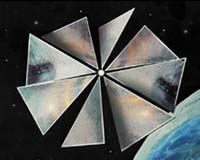
Washington - Feb 26, 2003 The development of the Cosmos 1 solar sail spacecraft is going well despite some delays with some of the spacecraft electronics. We are, however, waiting for problems to be resolved with our launch vehicle, the Volna. Until then, we are prisoners on Earth, trapped in our planet's gravity well. During the sub-orbital test launch in July 2001 the solar sails failed to deploy because of problems during the test vehicle's separation from the rocket. At the time we thought the vehicle failed to separate from the launcher, but later events have cast doubt on that assessment. In July 2002, a European payload failed to separate properly from its Volna launcher during another sub-orbital flight. Telemetry revealed that the problem was not a failure to separate, but rather a premature separation of the payload while it was still inside the second stage of the rocket. An extensive failure commission set up by the Russian space agency concluded that the cause of the 2001 and 2002 problems was most likely the same. As a result they have grounded the Volna until changes to the payload separation system can be implemented and thoroughly tested. It is strongly suspected that the payload separation problem was caused by a malfunction of the second-third rocket stage separation., This is likely a result of a design change made when the Volna was converted from an ICBM to a peaceful civil payload launcher. It seems that the redesign of the joint between the second and third stages of the rocket did not adequately account for the combination of forces during launch Correcting the problem is relatively simple, but the test program to verify that it is correct is not. The Russian space agency is demanding an extensive series of ground tests. These would involve, among other things, a drop tower vacuum chamber in which the second and third stage separation can be tested simulated free flight in space. This test program will be conducted at the Makeev Rocket Design Bureau in Miass, Russia. They are responsible for the Volna launch vehicle. Although regrettable, this is hardly a unique situation in the space business. The recent failures of the Proton and Ariane 5 and other examples show that payloads often have to wait for launch vehicles. The Makeev test is currently scheduled for April, but it cannot begin until they receive engineering hardware from our project at the Babakin Center. That engineering model hardware is being used right now in thermal-vacuum tests on the spacecraft. Once these tests are completed, the model will be shipped to Makeev. All components for the spacecraft, save one radio system, have now been delivered and system tests are underway. The development of the new S-band radio by our Russian and Ukrainian contractors has proved more difficult than expected. Nevertheless, its completion should not delay the spacecraft's assembly. The final assembly will probably be done in late May or early June, after all ground tests on the engineering model and electronics are complete. The ground tests on the Volna will help determine whether another sub-orbital test flight will be required. If it has to be done, further delays are to be expected. Our hope is that the ground tests will prove satisfactory, so that no sub-orbital flight will be necessary. We, like our colleagues at Babakin and at Makeev have to weigh the additional value of another flight test against the diversion and delay it can cause. This is especially true as the requirements for a sub-orbital flight are very different from orbital flight requirements. If the ground tests and verification of payload separation go well at Makeev, and all spacecraft tests go well, we will launch about two months after the final assembly. This means July at the earliest, but possibly not until September. Delays are disappointing and they cost us extra money. The failures connected with the launch have also made us more sensitive to other possible failures in getting the spacecraft into orbit and operating successfully. We are making some additions to our flight plan to increase reliability, and these too cost us money. This is typical in aerospace work, but it is hard on a space-interest group working with private funds. Amid the trees, we must not lose sight of the forest. The launch vehicle problem is completely unrelated to our solar sail spacecraft. Solar sailing has not advanced since the mid 1970s because no one has been able to procure an affordable launch vehicle and build a working spacecraft. We still have the best hope of ANYONE to fly the first solar sail mission. Community Email This Article Comment On This Article Related Links Solar Sales at The Planetary Society SpaceDaily Search SpaceDaily Subscribe To SpaceDaily Express Rocket Science News at Space-Travel.Com
 Successful First Test For Vega's Zefiro 9 Engine
 Paris, France(ESA) Dec 28, 2005
Flames, smoke and a deafening noise accompanied the first firing test of Vega's Zefiro 9 third-stage solid rocket motor. A first examination of the data indicates that everything went well at the test carried out yesterday at Salto de Quirra in southeast Sardinia. |
|
|

| The content herein, unless otherwise known to be public domain, are Copyright 1995-2006 - SpaceDaily.AFP and UPI Wire Stories are copyright Agence France-Presse and United Press International. ESA PortalReports are copyright European Space Agency. All NASA sourced material is public domain. Additionalcopyrights may apply in whole or part to other bona fide parties. Advertising does not imply endorsement,agreement or approval of any opinions, statements or information provided by SpaceDaily on any Web page published or hosted by SpaceDaily. Privacy Statement |