
 |
 |
 |
 |
 |
 |
 |
 |
 |

 |
Solar Reactor Heads To Europe For Testing
Washington DC (SPX) Jun 30, 2008 A research team from Valparaiso University's College of Engineering will take a solar reactor they've designed and built from scratch to Switzerland next month to begin a series of tests at one of the world' premier solar energy research institutes. Valparaiso is a member of the Council on Undergraduate Research. Dr. Robert Palumbo, Jenny professor of emerging technology and one of the world's leading solar energy researchers, and three of his undergraduate students will spend four and a half weeks at the Paul Scherrer Institute as Valparaiso's solar energy research program enters its third year. The program was launched in August 2006 with a $300,000 grant from the National Science Foundation to study the industrial feasibility of high temperature solar electrolysis - a process that has the potential to make large-scale storage and transportation of the sun's energy practical. "We started with nothing other than theory to design our solar reactor, so it's exciting to reach the point where we can begin testing," said Dr. Palumbo, who formerly served as head of the Paul Scherrer Institute's High Temperature Solar Technology Laboratory. "Our emphasis this summer will be validating that the reactor can perform under our desired operating conditions." During tests, sunlight will be collected, focused and directed into Valparaiso's reactor - a cylindrical device about three-feet long where the electrolytic process will take place. Inside the reactor, a crucible containing the chemicals involved in the electrolytic process will be heated to between 1,700 to 3,000 degrees Fahrenheit, at which point electrolysis will begin and separate zinc oxide into oxygen and metallic zinc. The team plans to spend its first few days in Switzerland testing the mechanical behavior of the reactor, finding out how it behaves when exposed to sunlight that's been concentrated thousands of times beyond what is experienced on a sunny day. Once Dr. Palumbo and his students determine their reactor can operate successfully - that its various components hold up under the extreme temperatures and that the inert gases contained within the reactor don't leak out - they will begin studying the electrolysis process itself. During that phase of testing, the team will conduct the electrolysis at different temperatures, different voltages and explore a variety of options for how electricity is supplied to the reactor. Valparaiso's research team is producing zinc in its experiments because the commonly-used metal could be used in fuel cells for the production of electricity. The process thus could be a means by which solar energy is stored as chemical energy in the form of zinc, allowing it to be transported and used at any time. The higher the temperature during electrolysis, the larger the amount of solar energy that can be substituted for the electricity needed to convert zinc oxide into metallic zinc. Over the past two years, students have spent a considerable amount of time investigating and addressing the problem of electrical resistance in the electrolysis cell, since less resistance means that less electricity needs to be added to the solar electrolysis process. Working with Dr. Palumbo are senior mechanical engineering and German majors Katie Krueger of Maumee, Ohio; Peter Krenzke of Plainfield, Ind.; and Nate Leonard of Dexter, Mich. Leonard is looking forward to observing the performance of the solar reactor he and other engineering students have worked together to build. "There are a lot of challenges to overcome in high temperature solar electrolysis," Leonard said. "We'll learn a lot from our experiments this summer, and it's rewarding to know our research could help lead to industrial use down the road." This summer's research at the Paul Scherrer Institute will set the stage for further testing of the solar reactor in the 2009 and 2010. "It will take more than one month to complete our testing of the electrolysis process and determine whether we can indeed replace electricity with solar energy on an industrial scale," Dr. Palumbo. "This summer is the initial step in testing that will continue over the next two summers." After the team returns to Valparaiso in August, Dr. Palumbo and his students will take the data they've collected and begin making improvements to the reactor. "I expect our testing will show us a number of improvements we can make, so that next summer we'll have a reactor that we're really happy with," he said. "Then, we can concentrate more on the science of solar electrolysis." Community Email This Article Comment On This Article Share This Article With Planet Earth
Related Links Council on Undergraduate Research (CUR) All About Solar Energy at SolarDaily.com
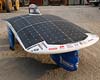
 Engineering students create solar car
 Evanston, Ill. (UPI) Jun 27, 2008
 A solar car created by engineering students is being road-tested in preparation for this summer's North American Solar Challenge. |
|
|

| The content herein, unless otherwise known to be public domain, are Copyright 1995-2007 - SpaceDaily.AFP and UPI Wire Stories are copyright Agence France-Presse and United Press International. ESA Portal Reports are copyright European Space Agency. All NASA sourced material is public domain. Additional copyrights may apply in whole or part to other bona fide parties. Advertising does not imply endorsement,agreement or approval of any opinions, statements or information provided by SpaceDaily on any Web page published or hosted by SpaceDaily. Privacy Statement |
 del.icio.us
 Digg
Digg Reddit
 YahooMyWeb
 Google
 Facebook