|
 |
 |
 |
 |
 |
 |
 |
 |

 |
Solar Energy: Charged For The Future
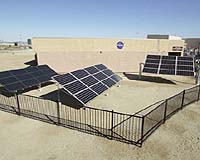
San Francisco CA (SPX) Sep 11, 2006 Once regarded as costly and impractical, solar technology is now poised to play a larger role in the future, thanks to new developments that could result in lower costs and improved efficiency. Potential applications include cell phones, computers, automobiles, homes and office buildings. The American Chemical Society will address the progress and challenge of this technology during a first of its kind symposium, "Science and Technology of Next Generation Photovoltaics," from Sunday, Sept. 10, through Tuesday, Sept. 12, in San Francisco during the Society's 232nd national meeting. All papers in this symposium, which begins at 8:30 a.m. on Sunday, will be presented at the San Francisco Marriott, Salon C2. Here are a few highlights of research toward improving the efficiency of solar cells: "Plastic" solar cells show gains in performance -- Nobel Prize winner Alan J. Heeger, Ph.D., and colleagues at the University of California, Santa Barbara, say that new developments in "plastic" solar cells, particularly chemical modifications to titanium oxide layers, could provide efficiencies of up to 15 percent in the future. He already has developed plastic solar cells with efficiencies between 5 percent and 6 percent, considered among the highest to date for this type of solar cell. These developments could pave the way for wider use of plastic solar cells, a type of conducting polymer, which are increasingly seen as a low cost, efficient and long-lasting source of solar energy. Heeger, a professor at the University, shared the 2000 Nobel Prize in Chemistry for his contributions toward the discovery of plastics that conduct electricity. His presentation will be delivered by study co-author and University colleague Kwanghee Lee, Ph.D. (PMSE 020, Sunday, Sept. 10, 8:35 a.m.) Ultrathin, dye-sensitized solar cells called most efficient to date -- Researchers in Switzerland have developed dye-sensitized solar cells that have reached the highest efficiencies to date among a new generation of thin film photovoltaic devices that show promise as a low-cost energy source. The new cells, composed of an ultrathin film of nano-sized semiconductor crystals such as titanium dioxide, have been shown in laboratory studies to produce efficiencies of 11 percent, whereas most new solar cells have efficiencies between 4 percent and 5 percent, according to Michael Graetzel, Ph.D., a chemist at the Swiss Federal Institute of Technology, Lausanne. These cells, which can be engineered into inexpensive, flexible sheets, could be used as coatings on glass windows to supply electric power to homes and businesses or as coatings on tents to supply power for soldiers in the field. The cells could be used in consumer applications within two to three years, the researcher says. (PMSE 174, Tuesday, Sept. 12, 8:30 a.m.) Carbon nanotubes could boost efficiency of solar cells -- Researchers at the University of Notre Dame in Indiana say they have found a new and promising way to boost the efficiency of solar cells. In preliminary studies, carbon nanotubes that were engineered into the architecture of semiconductor solar cells (composed of cadmium sulfide, zinc oxide and titanium dioxide) resulted in a doubling of the cells' photoconversion efficiencies (converting light into energy). In some cases, the efficiency of solar cells jumped from 5 percent to 10 percent in the presence of carbon nanotubes, according to Prashant Kamat, Ph.D., a professor of chemistry at the University. Carbon nanotubes also could be added to other types of solar cells, such as dye-sensitized solar cells and organic solar cells based on conducting polymers, to create similar or even stronger efficiency boosts, he says. (PMSE 094, Tuesday, Sept. 12, 11:20 a.m.) ### The American Chemical Society -- the world's largest scientific society -- is a nonprofit organization chartered by the U.S. Congress and a global leader in providing access to chemistry-related research through its multiple databases, peer-reviewed journals and scientific conferences. Its main offices are in Washington, D.C., and Columbus, Ohio. Community Email This Article Comment On This Article Related Links American Chemical Society Powering The World in the 21st Century All About Solar Energy at SolarDaily.com
 Organic Semiconductors Make Cheap And Flexible Photovoltaics And LEDs
 Ithica NY (SPX) Sep 10, 2006
Imagine T-shirts that light up, or a beach umbrella that collects solar energy to run a portable TV. How about really cheap solar collectors for the roof? All this and more could come from cutting-edge research at Cornell that demonstrates a new type of organic semiconductor device which shows electroluminescence and acts as a photovoltaic cell. |
|
|

| The content herein, unless otherwise known to be public domain, are Copyright 1995-2006 - SpaceDaily.AFP and UPI Wire Stories are copyright Agence France-Presse and United Press International. ESA PortalReports are copyright European Space Agency. All NASA sourced material is public domain. Additionalcopyrights may apply in whole or part to other bona fide parties. Advertising does not imply endorsement,agreement or approval of any opinions, statements or information provided by SpaceDaily on any Web page published or hosted by SpaceDaily. Privacy Statement |