|
 |
 |
 |
 |
 |
 |
 |
 |

 |
Solar Contribution To Global Warming Predicted To Decrease
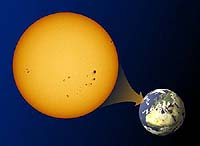
London - Oct 07, 2003 New research on the sun's contribution to global warming is reported in this month's Astronomy & Geophysics. By looking at solar activity over the last 11,000 years, British Antarctic Survey (BAS) astrophysicist, Mark Clilverd, predicts that the sun's contribution to warming the Earth will reduce slightly over the next 100 years. This is a different picture to the last century when solar flares, sunspots and geomagnetic storms, increased in number. This rise is simultaneous with emissions of greenhouses gases and an estimated increase in solar heat output, which together have warmed the Earth's temperature by a global average of 0.7 degrees centigrade. The solar contribution to the increase is variously estimated to be around 4-20% leaving greenhouse gases to make up the remaining 80%. Clilverd and colleagues conclude that solar activity is about to peak and predict less activity in the next 100 years, with the occurrence of space storms likely to decline by two thirds. Their assumption is that the solar heat output will decline slightly accordingly. Clilverd examined data from sun spot activity, geomagnetic storm indices and looked at the variation of atmospheric radiocarbon derived from studies of tree rings and marine sediments to make his predictions. He says, "This work is speculative and relies on the idea that the sun shows regular cycles of activity on timescales of 10 � 10,000 years and that its heat output and activity are related. But we believe the work is well grounded and the effect of solar activity on Earth's environmental system will not increase in the way it has during the last century. We should take this into account when trying to understand the impact of human activity on our climate system." Although solar activity may reduce in 2100, Clilverd predicts it will return to its current levels by 2200. Clilverd continues, "This research is important for understanding the severity and impact of climate change in coming centuries. As noted by Intergovernmental Panel on Climate Change in the Third Assessment Report, published in 2001, anthropogenic emissions of greenhouse gases are highly likely to cause warming of the Earth, but factors such as solar variability could amplify or subdue the effect." Community Email This Article Comment On This Article Related Links British Antarctic Survey SpaceDaily Search SpaceDaily Subscribe To SpaceDaily Express Dirt, rocks and all the stuff we stand on firmly
 Magnetic Reconnection Region Larger Than 2.5 Million Km Found In The Solar Wind
 Paris (ESA) Jan 12, 2006
Using the ESA Cluster spacecraft and the NASA Wind and ACE satellites, a team of American and European scientists have discovered the largest jets of particles created between the Earth and the Sun by magnetic reconnection. This result makes the cover of this week's issue of Nature. |
|
|

| The content herein, unless otherwise known to be public domain, are Copyright 1995-2006 - SpaceDaily.AFP and UPI Wire Stories are copyright Agence France-Presse and United Press International. ESA PortalReports are copyright European Space Agency. All NASA sourced material is public domain. Additionalcopyrights may apply in whole or part to other bona fide parties. Advertising does not imply endorsement,agreement or approval of any opinions, statements or information provided by SpaceDaily on any Web page published or hosted by SpaceDaily. Privacy Statement |