|
 |
 |
 |
 |
 |
 |
 |
 |

 |
Sodium Lidar Set Up At India's National MST Radar Facility
Gadanki, India (SPX) Jan 24, 2005 The National MST Radar Facility at Gadanki near Thirupati, under the Department of Space, has set up a Sodium Lidar, which is a ground based instrument for studying vertical and temporal structure of mesosphere and lower thermosphere (MLT) region. This is the first of its kind in India and will help in characterising the wind and wave induced sodium density. The first observation from the new Sodium Lidar was made on January 10, 2005. The occurrence of sporadic layers of neutral sodium and other metals at around 100 km heights is a phenomenon that is both interesting and puzzling. The shooting meteors are the genesis for the formation of atmospheric metal layers. As meteors enter the atmosphere, they burn-up or ablate and leave debris in their path. This ablation occurs near altitudes of 80 to 100 km. Part of this debris is neutral metal atoms and ions such as sodium, iron, potassium and calcium, which exist in this unique region as the air is thin for them to be trapped in compounds with oxygen but too thick to allow ionisation of all the neutral atoms into ions. This region of the atmosphere also hosts the airglow layers. Metal atoms are useful for remote sensing as they are shiny at specific resonant wavelengths. For atmospheric sodium this resonant wavelength is 589 nm, which appears as bright orange. Atmospheric sodium layer acts as tracers of winds and waves in this region. National MST Radar Facility is one of the prime centers for advanced research in atmospheric sciences. In addition to the state of art Mesosphere-Stratosphere-Troposphere (MST) radar, it has facilities such as the Lower Atmospheric Wind Profiler and Rayleigh/Mie Lidar. Very recently, Raman Lidar and Boundary Layer Lidar were set up. These facilities complement and supplement the MST radar for an integrated and comprehensive study of lower, middle and upper atmosphere. Sodium Lidar has further enhanced the scope of atmospheric research at this national facility. Community Email This Article Comment On This Article Related Links National MST Radar Facility ISRO SpaceDaily Search SpaceDaily Subscribe To SpaceDaily Express Climate Science News - Modeling, Mitigation Adaptation
 The Forgotten Methane Source
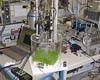 Heidelberg, Germany (SPX) Jan 11, 2006
In the last few years, more and more research has focused on the biosphere; particularly, on how gases which influence the climate are exchanged between the biosphere and atmosphere. Researchers from the Max Planck Institute for Nuclear Physics have now carefully analysed which organic gases are emitted from plants. |
|
|

| The content herein, unless otherwise known to be public domain, are Copyright 1995-2006 - SpaceDaily.AFP and UPI Wire Stories are copyright Agence France-Presse and United Press International. ESA PortalReports are copyright European Space Agency. All NASA sourced material is public domain. Additionalcopyrights may apply in whole or part to other bona fide parties. Advertising does not imply endorsement,agreement or approval of any opinions, statements or information provided by SpaceDaily on any Web page published or hosted by SpaceDaily. Privacy Statement |