|
 |
 |
 |
 |
 |
 |
 |
 |

 |
Sod Busters Along The Old Cambrian Trail
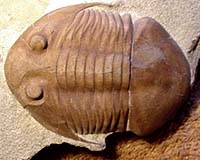
Denver - Oct 28, 2002 If you've ever had to scrape a barnacle, you can blame a trilobite for your trouble. The advent of trilobite-tilled, worm-worked muck a half-billion years ago may have helped feed an explosive evolution of early animal life in the oceans - including the sort of critters that today attach themselves to boats and piers. In the placid days before what's called the Cambrian Explosion of animal life, seafloor sediments were laid down in neat, firm layers, coated by microbial mats and remained undisturbed. Animals had no need to attach themselves to anything because the seafloor was firm and reliable. Then along came animals that had figured out how to mine the seafloor for food, changing the course of evolution forever. David Bottjer of the University of Southern California will explain the pivotal evolutionary role of what he calls the Cambrian "sod busters" at the annual meeting of the Geological Society of America on Monday, October 28, in Denver, CO. To learn how mud mining animals might have spurred evolution, Bottjer looked at ancient seafloor sediments in China and Canada from the period of time when the habit of churning, or "bioturbation," was spreading across the globe. He found that messier sediments held the remains of more kinds of advanced animals than the contemporary areas where microbial mats managed to hang on. The discovery suggested to Bottjer that churned up conditions created environmental pressure that led to the evolution of animals with noticeably different, even modern, lifestyles. "It's kind of a feedback thing," said Bottjer. "The change is creating change in other organisms." The new churning animals were themselves part of the Cambrian explosion of new kinds of beasts, but they also probably accelerated the burgeoning creation of new life forms by changing the environment and forcing earlier animals to adapt to harsher, backwater environments where the sodbusters couldn't survive, asserts Bottjer. The churning up of the sea floor also forced filter-feeding animals to evolve ways to attach themselves to rocks and shells so they could stay above the mess. By later in the Cambrian the seafloor had became very unstable, says Bottjer. Earlier animal forms had to move to rocks or shells of other organisms to stay alive. "They had adaptations that we see in the sea every day today." It was, in effect, the invention of the barnacle lifestyle, although barnacles as we know them today evolved much later. In contrast, during the earlier Precambrian animals had no need to adapt to muck. In those days the microbial mats ruled the world. So some of the earliest multicellular animals were probably "mat scratchers" that searched the pudding-like microbial surface for food. Others were "mat stickers" that stuck into mats and underlying sediments, like a fencepost, Bottjer explains. All that ended when worms, mollusks and trilobites came along and started tearing things up. Community Email This Article Comment On This Article Related Links Earth Sciences at University of Southern California SpaceDaily Search SpaceDaily Subscribe To SpaceDaily Express Explore The Early Earth at TerraDaily.com
 Scientists Find Evidence For Crucial Root In The History Of Plant Evolution
 New Orleans - Mar 26, 2003
If ancient plants had not migrated from the shallow seas of early Earth to the barren land of the continents, life as we know it might never have emerged. And now it appears this massive floral colonization may have been spurred by a single genetic mutation that allowed primitive plants to make lignin, a chemical process that leads to the formation of a cell wall. |
|
|

| The content herein, unless otherwise known to be public domain, are Copyright 1995-2006 - SpaceDaily.AFP and UPI Wire Stories are copyright Agence France-Presse and United Press International. ESA PortalReports are copyright European Space Agency. All NASA sourced material is public domain. Additionalcopyrights may apply in whole or part to other bona fide parties. Advertising does not imply endorsement,agreement or approval of any opinions, statements or information provided by SpaceDaily on any Web page published or hosted by SpaceDaily. Privacy Statement |