
 |
 |
 |
 |
 |
 |
 |
 |
 |

 |
Smells Like Bees' Spirit
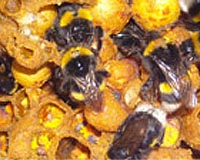
London UK (SPX) Aug 20, 2008 Bumblebees choose whether to search for food according to how stocked their nests are, say scientists from Queen Mary, University of London. When bumblebees return to the nest from a successful foraging mission, they produce a pheromone which encourages their nest mates to also go out and find food. Scientists had originally thought that these pheromones elicited a standard response from all bees. But new research from Queen Mary's School of Biological and Chemical Sciences has shown that bees' response to the pheromone changes according to their situation. Dr Mathieu Molet and Dr Nigel Raine have shown that worker bees are much more likely to respond to the pheromone and leave the nest in search of food, if the colony has little or no food reserves left. "Flying around all day to find nectar and pollen from flowers is hard work. So it makes sense that bees are more likely to respond to the pheromone when honey reserves are low," said Dr Molet. Writing in the journal Behavioral Ecology and Sociobiology, the Natural Environment Research Council funded team explain how they used radio-frequency identification (RFID) technology (the same electronic tagging system used in a London Underground oyster card) to automatically record the activity of bees in the lab. Different colonies of bumblebees (Bombus terrestris) were stocked with different levels of food reserves (honeypots). Artificial foraging pheromones were applied to the bees, and they were monitored over 16,000 'foraging bouts'. The response to the pheromones was stronger in colonies with less food - with more worker bees becoming active, and more foraging bouts being performed. The team's findings suggest that the pheromone can modulate a bumblebee's foraging activity - preventing needless energy expenditure and exposure to risk when food stores are already high. In future, such artificial pheromones could also be used to increase the effectiveness of bumblebee colonies pollinating commercial crops, such as tomatoes. Community Email This Article Comment On This Article Share This Article With Planet Earth
Related Links University of London
 Saving Our Bees
 Washington DC (SPX) Aug 06, 2008
Most of the world's plant species rely on animals to transfer their pollen to other plants. The undisputed queen of these animal pollinators is the bee, made up of about 30,000 species worldwide, whose daily flights aid in the reproduction of more than half of the world's flowering plants. |
|
|

| The content herein, unless otherwise known to be public domain, are Copyright 1995-2007 - SpaceDaily.AFP and UPI Wire Stories are copyright Agence France-Presse and United Press International. ESA Portal Reports are copyright European Space Agency. All NASA sourced material is public domain. Additional copyrights may apply in whole or part to other bona fide parties. Advertising does not imply endorsement,agreement or approval of any opinions, statements or information provided by SpaceDaily on any Web page published or hosted by SpaceDaily. Privacy Statement |
 del.icio.us
 Digg
Digg Reddit
 YahooMyWeb
 Google
 Facebook