|
 |
 |
 |
 |
 |
 |
 |
 |

 |
Smart Textiles Get First Museum Exhibition
New York (UPI) May 2, 2005 The Cooper-Hewitt National Design Museum is presenting an aspect of the 21st century science that has been given little public attention in the form of an enlightening exhibition of smart fibers and fabrics that will eventually change all our lives. "Extreme Textile: Designing for High Performance" is the first U.S. display of functional industrial textiles ever mounted and can be seen at the Cooper-Hewitt, a component of the Smithsonian Institution, through Oct. 30. It is expected to be one of the most heavily visited shows in the Manhattan museum's 108-year history. Matilda McQuaid, the exhibition's curator, said she selected the 150 examples of technical textiles on the basis of visual beauty as well as high engineering because there is "plenty of ugly stuff out there." As a result, the show has a high aesthetic quotient that makes visitors want to touch and stroke, and a number of displays are clearly designated as touchable. The material on exhibit ranges from a doily-size machine embroidery made of suture thread in the shape of a snowflake, to be implanted as connective tissue during reconstructive shoulder surgery, to a model of a 40-story skyscraper (Testa Architects, Los Angeles) constructed of a cross-hatched lattice made of carbon fiber that is stronger than steel. The super-strong outer walls allow for the interior of the building to be unobstructed by supports except for elevator wells. Among the most beautiful objects are a fabric made of conductive yarns overprinted with bright patterns in thermochromic inks that change color when heated by the yarns and an array of highly colored braided core-sheath ropes made of nylon for mountain climbing. Plastic woven mats that prevent soil from erosion also make lovely patterns when displayed over a lighted surface. McQuaid has arranged the show in five categories - stronger, faster, lighter, safer, and smarter. Beyond categorizing are carbon fiber prosthetic devices, such as the artfully curved "Cheetah" foot worn by gold medalist Marlon Shirley in the Paralympics, which allow amputees to walk, run, and jump with amazing ease, and a uniform developed by the U.S. Army that can monitor the vital signs of military personnel in a battle situation while providing live communication. Another material that can be put to wartime use is silver bobinette, a fabric often used for bridal veils. It is used as a radar decoy that wraps around any warship carrying the device. It deflects enemy missiles that lock onto the ship, and is bound to turn up in a Hollywood film any day now. A nice touch is the display of a replica of a cotton muslin wing section from the Wright brothers' 1902 glider, suspended near a prototype for a compact airplane made in 2004 by the University of Kentucky College of Engineering that was designed to explore Mars by remote control. It has an acrylate fabric wings designed to inflate when deployed and go rigid when struck by ultra-violet light.
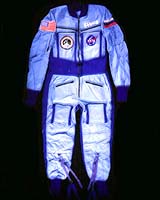
Textiles designed for space exploration abound. The Russian Penguin-3 suit used aboard the Mir space station contains a system of elastic textile inserts that relieve stress on the human body system caused by weightlessness. Collapsible gossamer-weight structures made of glass and carbon filaments, easily transported and made rigid on inflation, are designed for space colonization. For moon-walkers there is a liquid cooling garment designed for the Apollo missions. A whole section of the show is devoted to gloves, including a space glove incorporating pressure-sensitive textile switches designed for drivers of manned robots. For chefs and butchers there is an armored glove with guard plates inset in nylon fabric, and for barbed wire handlers there SuperFabric protective gloves developed by the U.S. Army. Carbon-X fabric gloves that cannot be set afire are designed for auto-racing drivers. Old-fashioned wool felt turns up in the form of self-lubricating gears and cogwheels, and glass fiber is being utilized in all sorts of sporting equipment such as a lightweight racing shell made of satin-weave glass fiber layered with non-woven carbon fiber that is also used for sculling oars. Yarn, in a new electroconductive form, is used by designer Maggie Orth for domestic light switches to provide a tactile experience in the form of pom-poms or fake fur. One of the displays that will be highly utilized in the future is the bandage-size Senseware body patch made of multi-sensor textile that will collect, process, and store physiological data that can be unloaded on a computer for viewing by a doctor or other healthcare professional. Also shown is a knitted polyester yarn sack for the human heart, designed to prevent enlargement of the heart in degenerative heart failure patients. It's a whole new world, and a visitor should allow several hours to take it all in. And don't forget to twang away at Squid Labs' harp-like structure of electronic ropes formed of braided polyester to transmit signals to a synthesizer that results in musical tones. The electronic device is designed to set off an alarm when the rope is fraying. It's pretty amazing, but so is the entire show. Community Email This Article Comment On This Article Related Links Cooper-Hewitt National Design Museum SpaceDaily Search SpaceDaily Subscribe To SpaceDaily Express Space Technology News - Applications and Research
 NGC Chosen To Proceed With Developing Solid-State Laser Technology For Military Applications
 Redondo Beach CA (SPX) Jan 09, 2006
Northrop Grumman Corporation has been selected to develop "military-grade," solid-state laser technology that is expected to pave the way for the U.S. military to incorporate high-energy laser systems across all services, including ships, manned and unmanned aircraft, and ground vehicles. |
|
|

| The content herein, unless otherwise known to be public domain, are Copyright 1995-2006 - SpaceDaily.AFP and UPI Wire Stories are copyright Agence France-Presse and United Press International. ESA PortalReports are copyright European Space Agency. All NASA sourced material is public domain. Additionalcopyrights may apply in whole or part to other bona fide parties. Advertising does not imply endorsement,agreement or approval of any opinions, statements or information provided by SpaceDaily on any Web page published or hosted by SpaceDaily. Privacy Statement |