|
 |
 |
 |
 |
 |
 |
 |
 |

 |
Smart-1 Impact Flash And Debris: Crash Scene Investigation
Paris, France (ESA) Sep 08, 2006 Timing, location, detection of a flash and of ejected material, and a firework generated by the lunar impact of ESA's SMART-1, are the latest results gathered thanks to the ground observation campaign of this historical event. "The successful capture of the SMART-1 impact from Earth raised a substantial interest in the amateur and professional astronomical community. They started to reanalyse the available data, to repeat observations of the impact site and to share the results worldwide as a family", says Pascale Ehrenfreund, coordinator of the SMART-1 impact ground observation campaign.
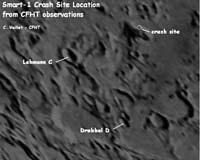
Where did SMART-1 impact the Moon? These times are remarkably in agreement with the last SMART-1 flight dynamics predictions of 3 September at 07:42:20 CEST (05:42:20 UT), in the location at 46.20 West longitude and 34.4 South latitude. This is also in agreement with the coordinates newly derived from the position of the infrared impact flash observed by the Canada-France-Hawaii telescope (CFHT). Extensive data processing is now going on to specify the topography of the impact site. From a preliminary analysis of the topographic stereo data available and earlier maps built with SMART-1 data, the satellite should have hit the Moon in the ascending slope of a mountain about 1.5 kilometres high, above the Lake of Excellence plain.
What happened? Dust after the flash From a detailed analysis of the CFHT infrared movie of the variations after the flash, a cloud of ejected material or debris travelling some 80 kilometres in about 130 seconds has been detected by observer Christian Veillet, Principal Investigator for the SMART-1 impact observations at CFHT. "It seems that some ejecta or debris made it across the mountain. This is good news to search for the ejecta blanket" says Foing." We might also see the 'firework' expansion of gas and debris that has bounced after impact from the spacecraft." Some SMART-1 campaign amateurs report that they may have observed the optical flash in their own data, and a possible impact afterglow. "We call for observers to search for the crater and ejecta blankets from SMART-1, in particular using visible or infrared imagery, or even to look at spectroscopic anomalies at the impact site," added Foing. "We also call all observers to send us their reports, thanking them for engaging in the SMART-1 adventure". Community Email This Article Comment On This Article Related Links SMART-1 Lunar Dreams and more Mars News and Information at MarsDaily.com Lunar Dreams and more
 European Probe Smashes Into Moon After Successful Mission
 Paris (AFP) Sep 03, 2006
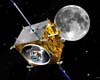
One of the most innovative missions in space exploration came to a dramatic close on Sunday as Europe's first probe to the Moon crashed into the lunar surface giving stargazers around the world an astronomical fireworks display. |
|
|

| The content herein, unless otherwise known to be public domain, are Copyright 1995-2006 - SpaceDaily.AFP and UPI Wire Stories are copyright Agence France-Presse and United Press International. ESA PortalReports are copyright European Space Agency. All NASA sourced material is public domain. Additionalcopyrights may apply in whole or part to other bona fide parties. Advertising does not imply endorsement,agreement or approval of any opinions, statements or information provided by SpaceDaily on any Web page published or hosted by SpaceDaily. Privacy Statement |