|
 |
 |
 |
 |
 |
 |
 |
 |

 |
Smart-1 Ready For Payload Commissioning
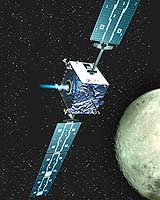
Paris - Jan 27, 2004 The spacecraft is now in its 194th orbit, in good status and with all functions performing nominally. As in previous weeks, the ion drive has only generated thrust around the perigee point to fine-tune the altitude of the apogee point. This strategy has produced a noticeable increase in apogee height, see plot below, which is necessary to minimize the duration of eclipse periods that will occur during March. The total cumulated thrust so far of more than 1600 hours, consuming 25.7 kg of Xenon, has provided a velocity increment of about 1150 ms-1 (equivalent to 4140 km per hour). This week the electric propulsion engine's performance, periodically monitored by means of the telemetry data transmitted by the spacecraft and by radio-tracking by the ground stations, has been nominal. The Smart-1 Science and Technology Working Team (STWT20) met at ESOC on the 15 January 2004. The main objectives were to give the status of the payload (PL) commissioning and plan future activities. Present at the meeting were instrument Principal Investigators (PIs), Technology Investigators (TIs), Flight Control Teams from ESOC and representatives of the Flight Dynamics Group. This unique combination of resources presented much useful information for the planning of the coming activities. The Flight Dynamics Group presented a thrusting strategy for the coming months, which will drive both the commissioning-calibration and cruise phases. The plasma diagnostic experiments, EPDP and SPEDE, have been operational since the first week of the mission and have measured the spacecraft environment during both periods of electric thrust and no thrust. These early results were discussed at a workshop held at ESTEC on 20 January. On the morning of Sunday 18 January, the AMIE camera took its first test image of a crescent Moon. This image will be included in a later status report. From 1 February to 22 February 2004, the electric propulsion (EP) will cease. The resulting stable, defined, spacecraft orbit is ideal for payload commissioning and targeted pointings. The AMIE camera will acquire images from a series of targets, and the SIR infrared and D-CIXS X-ray spectrometers will obtain their first spectra. During March, there will be a period of EP thrusting and long eclipses, which will limit the payload to simple operations at apogee. Once this period has finished, normal operations can resume and an extended commissioning and cruise science phase will operate from April-June during the coast arcs. A series of lunar resonance gravity assists will take place on 20 August, 16 September and 14 October. The STWT20 agreed to have only one lunar swingby, on or around 9 November, before lunar capture takes place in early December. After capture and down spiral, the xenon fuel reserves will lower the apolune to the final science orbit. Smart-1 Community Email This Article Comment On This Article Related Links SpaceDaily Search SpaceDaily Subscribe To SpaceDaily Express Mars News and Information at MarsDaily.com Lunar Dreams and more
 SMART 1 Uses New Imaging Technique In Lunar Orbit
 Paris, France (ESA) Dec 28, 2005
ESA's SMART-1 spacecraft has been surveying the Moon's surface in visible and near-infrared light using a new technique, never before tried in lunar orbit. |
|
|

| The content herein, unless otherwise known to be public domain, are Copyright 1995-2006 - SpaceDaily.AFP and UPI Wire Stories are copyright Agence France-Presse and United Press International. ESA PortalReports are copyright European Space Agency. All NASA sourced material is public domain. Additionalcopyrights may apply in whole or part to other bona fide parties. Advertising does not imply endorsement,agreement or approval of any opinions, statements or information provided by SpaceDaily on any Web page published or hosted by SpaceDaily. Privacy Statement |