|
 |
 |
 |
 |
 |
 |
 |
 |

 |
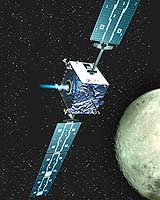
Smart-1 Edging Out Slowly To The Moon
Paris - Oct 22, 2003 The spacecraft is now completing its 50th orbit and has completed more than 560 hours in space. The main actvity of the last week has been to repeatedly use the electric propulsion engine to gradually alter the spacecraft's orbit. This is limited to around 15 hours a day based on whether the spacecraft is in eclipse. So far the engine has generated thrust for an accumulated time of about 240 hours. The electric propulsion engine performance has been periodically monitored by means of telemetry data transmitted by the spacecraft and by radio-tracking at the ground stations. The EP performance has been constantly improving, as expected, during the thrusting phase. During the first firing we measured an underperformance of about 3%, as expected in the early operations of the engine in its first use. Today we have a slight over-performance of about 0.5% which gives us confidence in the excellent conditions of the electric propulsion system. The electric power provided by the solar arrays is nominal. The expected degradation due to the radiation environment is less severe then the worst case scenario. We can, therefore, assume that we shall be able to thrust at full power for quite some time. The thermal subsystem is performing very well: all the temperatures are as expected and the heater power consumption is lower than estimated. This is a comfortable situation and gives us confidence that the system will be able to cope well with the long eclipse seasons in the spring of next year. The communication, data handling and on-board software subsystems have been performing nominally so far. The attitude control subsystem has, in general, been working very well and the controller performance during the thrusting phase has been so smooth and accurate that there has been no need to use the hydrazine thrusters to desaturate the small reaction wheels used as main actuators. The main area of concern is the star tracker performance. This advanced autonomous star mapper has recently failed to provide good attitude information in a few cases around perigee and eclipse periods. Although the attitude control system can cope with these occasional problems, the spacecraft planned operations are disturbed by these events. The operation team at ESOC is obliged to reschedule the operations to take into account these events. In the meantime the ESTEC project and industry teams are busy trying to find an explanation to these anomalies. Despite this inconvenience the thrusting periods are maintained. More on the subject will be provided in future reports. The SMART-1 orbit is continuously modified by the effects of the electric propulsion low thrust. The osculating orbital elements are periodically computed by the ESOC specialists. These elements define the so called 'osculating orbit' which would be travelled by the spacecraft if at that instant all perturbations, including EP thrust, would cease. So it is an image of the situation at that moment. In reality the path travelled by the spacecraft is a continuous spiral leading from one orbit to another. In this diagram the GTO, the osculating orbits at launch and at different times are plotted. The large orbit, marked 'final', is the one we expect to achieve at the end of the radiation belt escape in about two months. From the start, the electric propulsion system has managed to increase the semi-major axis of the orbit by 1555 km, increasing the perigee altitude from the original 656 km to 2035 km and the orbital period by more than one hour, from the initial 10 hours 41 minutes to the present 11 hours 42 minutes. Community Email This Article Comment On This Article Related Links Smart-1 SpaceDaily Search SpaceDaily Subscribe To SpaceDaily Express Mars News and Information at MarsDaily.com Lunar Dreams and more
 SMART 1 Uses New Imaging Technique In Lunar Orbit
 Paris, France (ESA) Dec 28, 2005
ESA's SMART-1 spacecraft has been surveying the Moon's surface in visible and near-infrared light using a new technique, never before tried in lunar orbit. |
|
|

| The content herein, unless otherwise known to be public domain, are Copyright 1995-2006 - SpaceDaily.AFP and UPI Wire Stories are copyright Agence France-Presse and United Press International. ESA PortalReports are copyright European Space Agency. All NASA sourced material is public domain. Additionalcopyrights may apply in whole or part to other bona fide parties. Advertising does not imply endorsement,agreement or approval of any opinions, statements or information provided by SpaceDaily on any Web page published or hosted by SpaceDaily. Privacy Statement |