|
 |
 |
 |
 |
 |
 |
 |
 |

 |
Smallest Satellites Ever Contacted
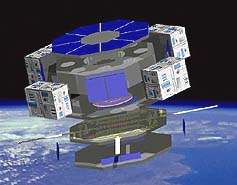
El Segundo - February 8, 2000 - Engineers from The Aerospace Corporation have established effective two-way communications with the smallest satellites ever released into orbit. The two picosatellites measure 4-by-3-by-1 inches and weigh less than one-half pound each. In passes over the ground station at Menlo Park, Calif., Monday evening and Tuesday morning the engineers received data and transmitted commands. It was determined that the tethered satellites were released Sunday evening from their "mother" satellite, OPAL, built by Stanford University students. OPAL stands for Orbiting Picosat Automated Launcher. Engineers have commanded the tiny satellites to switch to low-power mode except when they appear over the ground station. This is to conserve power. They are to transmit beacon signals when over the ground station. The satellites also have been commanded to exercise microelectromechanical systems (MEMS) radio frequency switches designed by Rockwell Science Center, Thousand Oaks, Calif. The switches are the primary mission payload. The picosatellites were designed and built by The Aerospace Corporation, El Segundo, Calif., under funding from DARPA, the Defense Advanced Research Projects Agency. The Aerospace Corporation tested and integrated the satellite components and conceived the mission. The picosatellites are considered a link toward slightly larger and more sophisticated nanosatellites envisioned as tiny space workhorses of the future. Dan Oltrogge, head of The Aerospace Corporation's tracking team, said locating the tiny picosats was like "finding a needle in a haystack." He credited the U.S. Space Command's Space Surveillance Network based in Colorado Springs with getting a good fix on the satellites. In a tether connecting the two satellites are thin strands of gold to facilitate pickup by radar. He said the mission so far has been "wildly successful" given its complexities. These include a new four-stage launch vehicle--the Air Force's Orbital Suborbital Program Space Launch Vehicle constructed from refurbished Minuteman II rocket motors and Pegasus XL motors--and the succession of satellite deployments. OPAL, a university satellite, was released by JAWSAT, the joint Air Force Academy Weber State University Satellite, and the picosatellites were released from OPAL.
Email This Article Comment On This Article Related Links Space
 Satellite Launch To Boost DTH In India
 Calcutta, India (SPX) Dec 28, 2005
The successful launch Thursday of India's heaviest satellite from spaceport of Kourou in French Guyana may have boosted the country's space research efforts to yet another level, but it has also lifted the spirits of at least three Direct-To-Home televisions broadcasters, one of which has been waiting for years to launch its services in India. |
|
|

|
|
|
|
|
|
|
|
|
|
|
|
| The content herein, unless otherwise known to be public domain, are Copyright 1995-2006 - SpaceDaily.AFP and UPI Wire Stories are copyright Agence France-Presse and United Press International. ESA PortalReports are copyright European Space Agency. All NASA sourced material is public domain. Additionalcopyrights may apply in whole or part to other bona fide parties. Advertising does not imply endorsement,agreement or approval of any opinions, statements or information provided by SpaceDaily on any Web page published or hosted by SpaceDaily. Privacy Statement |