|
 |
 |
 |
 |
 |
 |
 |
 |

 |
Small is beautiful: Incredible shrinking memory drives new IT
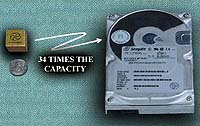
Paris (AFP) Oct 9, 2007 Over the past decade, hard drives have shrunk to the size of postage stamps while their storage capacity has improved fifty-fold, a feat that can be traced to two men who won the 2007 Nobel Prize for Physics on Tuesday. From MP3 players to cameras to laptops, most of the gadgets that store the digital threads from which our daily lives are increasingly woven owe their enhanced power to this hard-disk breakthrough. "It has revolutionized everything from iPods to mobile phones," said Matin Durrani, editor of Physics World, a journal published by Britain's Institute of Physics. Along with people in the trillion-dollar hard-drive industry, Durrani was delighted that the physics Nobel -- usually given for highly theoretical work with scant practical application -- recognized research that had tangibly changed lives. "It shows that physics has a real relevance not just to understanding natural phenomena but to real products in everyday life," he said. Albert Fert of France and Peter Gruenberg of Germany have been lauded for discovering the principle, called giant magnetoresistance (GMR), that led to this breakthrough. Working at the atomic scale of nanotechnology, they independently discovered in 1988 that tiny changes in magnetic fields can yield a large electric output, something physicists at the time did not think possible. These differences in turn cause changes in the current in the readout head which scans a hard disk to spot the ones and zeroes in which the data is stored. "The real payoff is being able to use smaller and smaller magnetic domains. This translated directly into greater density of data," said Phil Schewe of the American Institute of Physics. In a quarter-century, a computer of comparable computing power shrank from the size of a large room, to a fridge and then a laptop, he said. "And now you can fit more than a trillion bits of data onto a tiny handheld device, such as an iPod or an Blackberry," Schewe said. The information revolution has long obeyed "Moore's Law," which says advances in the miniaturization of electronic circuitry enable silicon chips to double in power roughly every 18 months. In the mid-1990s, though, it looked as if that blistering pace of evolution would be braked by the limitations of hard-disk technology. Hard disks could not store enough data relative to their size and the induction coil, used for extracting the data, was a bad choke point. Fert and Gruenberg were able to prove that their concept of packing more information into less space worked. But they could not find a way to ramp up to industrial-scale production. That breakthrough came from the laboratory of Stuart Parkin, an experimental physicist at IBM who applied something called "sputtering" techniques to create GMR structures, which are thin magnetic layers separated by non-magnetic metals. IBM introduced the new technology in its disk-drive products in 1997 and was quickly followed by the rest of the industry. Technology based on GMR "may be regarded as the first step in developing a completely new type of electronics, dubbed 'spintronics'," the Nobel jury said in announcing the award. Unlike traditional electronics, spintronics uses not only an electrical charge but the spin of electrons in individual atoms. This quantum mechanical effect, the jury predicts, will be the basis of a new kind of computer memory -- MRAM, or magnetic working memory -- that will be as fast as today's temporary memory but will be permanent at the same time. "People keep saying there are limits to how small we can make things," said Schewe. "But clever physicists keep finding ways to cheat Moore's Law and cram more information in." Community Email This Article Comment On This Article Related Links Space Technology News - Applications and Research
 New Transparent Plastic Strong As Steel
 Ann Arbor MI (SPX) Oct 08, 2007
By mimicking a brick-and-mortar molecular structure found in seashells, University of Michigan researchers created a composite plastic that's as strong as steel but lighter and transparent. It's made of layers of clay nanosheets and a water-soluble polymer that shares chemistry with white glue. |
|
|

| The content herein, unless otherwise known to be public domain, are Copyright 1995-2007 - SpaceDaily.AFP and UPI Wire Stories are copyright Agence France-Presse and United Press International. ESA Portal Reports are copyright European Space Agency. All NASA sourced material is public domain. Additional copyrights may apply in whole or part to other bona fide parties. Advertising does not imply endorsement,agreement or approval of any opinions, statements or information provided by SpaceDaily on any Web page published or hosted by SpaceDaily. Privacy Statement |