|
 |
 |
 |
 |
 |
 |
 |
 |

 |
Skylab 30 Years Later
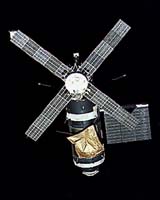
Washington - Nov 11, 2003 It's been three years since the first human inhabitants took up residence aboard the International Space Station (ISS). Since then, the ISS has been home to eight resident crews who have performed fantastic research in the microgravity of Earth orbit. But none of this would have been possible without America's first space station: Skylab. From its launch on May 14, 1973, until the return of its third and final crew on Feb. 8, 1974, the Skylab program proved that humans can live and work in outer space for extended periods of time. Pete Conrad, Paul Weitz and Joe Kerwin spent 28 days in orbit as the first crew of Skylab. The second crew - Alan Bean, Jack Lousma and Owen Garriott - spent 59 days in space. The final Skylab crew spent 84 days in space and consisted of Jerry Carr, Bill Pogue and Edward Gibson. Each Skylab crew set new spaceflight duration records. The record set by the final crew was not broken by an American astronaut until the Shuttle-Mir program more than 20 years later. Skylab served as the greatest solar observatory of its time, a microgravity lab, a medical lab, an Earth-observing facility, and, most importantly, a home away from home for its residents. The program also led to new technologies. Special showers, toilets, sleeping bags, exercise equipment and kitchen facilities were designed to function in microgravity. As successful as the program was, the first two crews had to overcome some unexpected challenges. During the station's launch, airflow caused a meteoroid shield to come off, tearing off one of two solar panels and preventing the other from deploying. The damage resulted in reduced power for the station. When the first crew arrived 11 days later, their first task was to repair the damage. Once repairs were complete, full power was restored. A thruster leak caused trouble for the second crew, causing Bean's rendezvous with the station to be more challenging than expected. Once they were on board, a second thruster developed a leak. Plans were drawn up for a rescue, but the crew was able to complete the mission as planned. Original plans called for the station to remain in space after the final Skylab mission, for another 8 to 10 years, possibly to be visited by the Shuttle fleet. But unexpectedly high solar activity foiled the plan, and on July 11, 1979, Skylab re-entered the Earth's atmosphere and disintegrated, dispersing debris across a sparsely populated section of western Australia and the southeastern Indian Ocean. "There was a certain small amount of sadness when we left, realizing we were going to be the last crew to inhabit the spacecraft," Carr said. "It had hung together beautifully for us, and we kind of hated to leave it. But, of course, we were also looking forward to going home."
Life on Skylab Days began on Skylab at 6 a.m. (Houston time) and lasted until 10 p.m. At the beginning of each day, the astronauts would check the teletype machine to see what their orders were from Mission Control for that day. The crew would then use the restroom, weigh, and eat breakfast. Their daily science assignments would rotate every day. Each took turns on things such as solar observation, and the astronaut who was the "guinea pig" for the medical evaluations one day would be performing those same evaluations on one of his crewmates the next. "Between 8 and 10 at night, we had free time," Carr said. "For the most part, the most fun was looking out the window." Off-duty free time was often filled with still more science experiments. "We had a number of other things to do," Garriott said. "We had the student experiments, for example." The crews also had fun devising their own small experiments, some of which were later turned into educational videos for students worldwide. Carr said he enjoyed this hobby. "It was such an interesting thing to turn loose a blob of water to see what you can do with it." They also pulled a classic prank on mission controllers. The ground crew was shocked when Garriott's wife, Helen, called down to them from the station. The roomful of controllers sat confused until the crew burst into laughter - Garriott had recorded his wife's voice before the flight, and rehearsed the prank with capcom Bob Crippen. Extra-vehicular activities (EVAs) had been scheduled from the beginning to change out the film in the Apollo Telescope Mount. However the EVAs eventually became necessary to repair the station. During the EVAs, Garriott said, it was a thrill to "look down this very long elevator shaft" to the surface of the Earth. "It's quite an interesting view," he said. None of the astronauts expressed any concerns about the potential physical effects of the unprecedented spaceflight durations. Returning to Earth did take a little adjustment, though. In addition to a few days of readjusting to the physical effects of gravity, astronauts sometimes forgot that things do not work the same on Earth as they do in space, attempting to let things float as they would in microgravity.
The Legacy of Skylab Much of the research and technology that makes the ISS possible was still just theory prior to launch of Skylab. "I think the greatest achievement is that we pretty much proved that the human body can stay weightless for a very long time," Carr said. "This was our first opportunity to go up and settle in." He said that the Skylab crews also helped develop countermeasures to help astronauts better endure long-duration flights. "I don't see any reason we couldn't go to Mars without artificial gravity," he said. When asked about the modern successor to the Skylab program, Garriott said that he believes the ISS could have a great future. "It's got great potential, but not with only two people onboard. We're still waiting expectantly for the potential to be realized." He said that he believes the ISS could be a very productive scientific facility once the crew size is increased. Carr said that he and fellow third-crew astronaut Pogue were actually involved in the development for 13 years of what became ISS, and were able to share their experiences during the design planning. "It looks to me like it's a good system," he said. The ISS still has a long future, and NASA and its international partners are working to make sure that ISS does realize its full potential. And, when it does, it will owe much of that success to another space station, which orbited the Earth 30 years ago - Skylab. Community Email This Article Comment On This Article Related Links Skylab at NASA Explores SpaceDaily Search SpaceDaily Subscribe To SpaceDaily Express Space Tourism, Space Transport and Space Exploration News
 Spicing Up Space Meals
 Los Angeles CA (SPX) Jan 04, 2006
Since its launch a year and half ago, Minimus.biz has quickly become the place to go for individual and travel size items. Last week, NASA came to Minimus.biz and purchased several different travel size condiments to send with the astronauts to the International Space Station. |
|
|

| The content herein, unless otherwise known to be public domain, are Copyright 1995-2006 - SpaceDaily.AFP and UPI Wire Stories are copyright Agence France-Presse and United Press International. ESA PortalReports are copyright European Space Agency. All NASA sourced material is public domain. Additionalcopyrights may apply in whole or part to other bona fide parties. Advertising does not imply endorsement,agreement or approval of any opinions, statements or information provided by SpaceDaily on any Web page published or hosted by SpaceDaily. Privacy Statement |