Energy News  
Sister Moons, Dione And Tethys

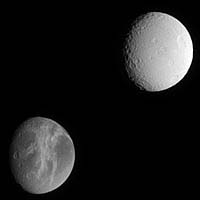
Dione And Tethys.

Pasadena CA (JPL) Apr 21, 2005
Cassini offers this lovely comparison between two of Saturn's satellites, Dione and Tethys, which are similar in size but have very different surfaces.

Extensive systems of bright fractures carve the surface of Dione (1,118 kilometers, or 695 miles across).

The double-pronged feature Carthage Linea points toward the crater Turnus at the nine o'clock position near the terminator, and Palatine Linea runs toward the moon's bottom limb near the five o'clock position.

In contrast, the surface of Tethys (1,071 kilometers, or 665 miles across) appears brighter and more heavily cratered. The large crater Penelope is near the eastern limb.

The huge rift zone Ithaca Chasma, which is 3 to 5 kilometers (2 to 3 miles) deep and extends for about 2,000 kilometers (1,200 miles) from north to south across Tethys, is hidden in shadow just beyond the terminator.

For comparison, the Grand Canyon in Arizona is about 1.5 kilometers (1 mile) deep, and about 450 kilometers (280 miles) long.

The image was taken in visible light with the Cassini spacecraft narrow-angle camera on March 7, 2005, at a distance of approximately 1.5 million kilometers (908,000 miles) from Tethys and 1.6 million kilometers (994,000 miles) from Dione.

The image scale is 9 kilometers (6 miles) per pixel on Tethys, and 10 kilometers (6 miles) per pixel on Dione.


Community
Email This Article
Comment On This Article

Related Links
SpaceDaily
Search SpaceDaily
Subscribe To SpaceDaily Express
Explore The Ring World of Saturn and her moons
Jupiter and its Moons
The million outer planets of a star called Sol
News Flash at Mercury


Memory Foam Mattress Review
Newsletters :: SpaceDaily :: SpaceWar :: TerraDaily :: Energy Daily
XML Feeds :: Space News :: Earth News :: War News :: Solar Energy News


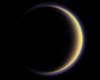
Cassini Images Halo Around Titanic Moon Off Saturn
Pasadena CA (SPX) Dec 27, 2005
With its thick, distended atmosphere, Titan's orange globe shines softly, encircled by a thin halo of purple light-scattering haze.


  • Spontaneous Ignition Discovery Has ORNL Researcher Fired Up
  • Scientists Discover Better Way To Generate Power From Thermal Sources
  • GM Delivers First Fuel Cell Truck To US Army
  • China, US Sign Deal For Cooperation In Clean Technologies

  • Study Uncovers Bacteria's Worst Enemy
  • India Signs Nuke Safety Treaty
  • China Plans To Build 40 New Nuclear Reactors In Next 15 Years
  • New Alloy Verified For Safer Disposal Of Spent Nuclear Energy Fuel


  • NASA Uses Remotely Piloted Airplane To Monitor Grapes


  • Boeing Procurement Scandal Spawns 48 Air Force Reviews: General
  • Who Will Win: Boeing Or Airbus?
  • Airbus, Space Activities Lift EADS 2004 Profit By 60 Percent
  • Fossett Commits To Final Dash To Kansas

  • NASA plans to send new robot to Jupiter
  • Los Alamos Hopes To Lead New Era Of Nuclear Space Tranportion With Jovian Mission
  • Boeing Selects Leader for Nuclear Space Systems Program
  • Boeing-Led Team to Study Nuclear-Powered Space Systems

  • The content herein, unless otherwise known to be public domain, are Copyright 1995-2006 - SpaceDaily.AFP and UPI Wire Stories are copyright Agence France-Presse and United Press International. ESA PortalReports are copyright European Space Agency. All NASA sourced material is public domain. Additionalcopyrights may apply in whole or part to other bona fide parties. Advertising does not imply endorsement,agreement or approval of any opinions, statements or information provided by SpaceDaily on any Web page published or hosted by SpaceDaily. Privacy Statement