|
 |
 |
 |
 |
 |
 |
 |
 |

 |
Sino-Indian Relations In New Gear
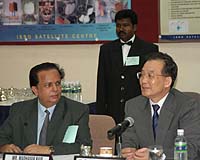
Singapore (UPI) Apr 11, 2005 A 47-year-old border dispute and frosty relations between China and India are being put aside as both countries' vested interests in bilateral trade and investment relations take over. Today's Sino-Indian relation remains as complex as ever, but both countries appear determined to enter a new area of diplomatic relation that could shape the 21st century's international diplomatic architecture. On Monday, China and India agreed on a five-year plan for comprehensive cooperation in economy and trade to promote bilateral ties and signed an agreement laying down the "guiding principles" for the settlement of their protracted boundary dispute. China has also indicated it will not oppose India's candidature for permanent membership of an expanded U.N. Security Council, a leap forward in China's previous position, which was less than lukewarm in supporting India's U.N. aspirations. The "strategic partnership," signed Monday after a four-day historic visit in India by Chinese Premier Wen Jiabao and India's Prime Minister Manmohan Singh, will promote diplomatic relations, economic ties and contribute to the two nations "jointly addressing global challenges and threats," according to a press statement. "In the short term, improving China-India relations are important for economic development not only in the two countries but also in the broad region. Setting aside territorial disputes enables the leaders of the two countries to end a half-century Cold War and focus on economic cooperation," said Yiping Huang, analyst at Citibank. "For China, better relations with India are critical for creating a more peaceful external environment for development, especially as its relations with the U.S. turned rocky while its relations with Japan soured recently. Likewise, relations with Chin a are also essential for India as it seeks to strengthen economic cooperation with the East Asian region and play a greater role in global affairs," Yiping added. During his visit, Wen talked about building a "bridge of friendship" with India, saying the two countries were set to take their growing ties "even closer," while Singh said the two countries could "together reshape the world order." Bilateral ties have markedly improved since June 2003, when the then-Indian Premier Atal Bihari Vajpayee visited China for the first time in a decade. Both countries appointed special representatives to discuss the Aksai Chin frontier issue in the northern Himalayas, still an unmarked border between them. Both sides have been laying claim to it since the Chinese invasion of India in 1962, with India saying China occupies about 15,000 square miles of territory in Kashmir, while Beijing claims some 35,000 square km. The first step in the "reconciliation" of the two countries came with India acknowledging the Tibetan Autonomous Region was part of China's territory and pledging not to allow "anti-China" political activities in India. Meanwhile, China had subtly acknowledged India's sovereignty over Sikkim (without explicitly mentioning as much) by agreeing to open a trading post along the border there and recognizing Nathu La as the pass for entry and exit for persons and trade. This time around, the political understanding between the two former enemies appears to have grown further, as each side becomes more sensitive to each other's concerns. "It's no longer a question of India versus China, but India and China driving the global economy," M.K. Ranganathan, the Indian Special Representative to China, told a television channel. "For the first time we see a commonality on both sides to find a solution," Indian National Securi ty Adviser M.K. Narayanan also told India's Star TV. Political analysts believe the invigorated new ties will send a signal to Washington that India is unhappy with the growing U.S.-Pakistan military relationship, while it appears clear Beijing is pursuing its vision of a multilateral polycentric world to counter American unilateralism. The recent Chinese diplomatic offensive is as much driven by concerns about diplomatic stability in the region, as economic vision. Bilateral trade between the two giants has increased sharply in recent years to about $13.6 billion in 2004 and is expected to reach $30 billion by 2010. China has been pushing for a Free Trade Agreement with India, which would create the biggest free trade region in the world. It is also striving for a closer cooperation in the high-tech sector, where it sees the two countries complementing each others. "Cooperation is just like t wo pagodas, one hardware and one software. Combined we can take the leadership position in the world," Wen noted during the weekend, calling for a closer cooperation to launch the "Asian century" of information technology. At a recent international forum her, academics pointed how much the two giants were learning from each others. Singapore Minister Mentor Lee Kuan Yew noted that the two were going to study each other's experiences and would "spur each other to excel, while Waheguru Pal Sigh Sidhu of the New York-based International Peace Academy said the two needed to accommodate each other as their growing economic ties gave them a stake in each other's destiny. Yet observers also said China's support of Pakistan's nuclear program remains a thorn in the side of the Sino-Indian relationship, even though there has been a subtle shift in Beijing's position on Pakistan vis-a-vis India, as it appears to want to take a "neutral" position between the two. Before coming to New Delhi, Wen visited Pakistan, and China agreed to build four F-22P frigates for the Pakistan Navy. Community Email This Article Comment On This Article Related Links SpaceDaily Search SpaceDaily Subscribe To SpaceDaily Express The Chinese Space Program - News, Policy and Technology China News from SinoDaily.com
 Taikonauts On Moon A Far Off Dream For China Yet
 Beijing (XNA) Jan 05, 2006
A one-year lunar fly-by mission may start in April 2007 in China, but a manned flight to the Earth's neighbour may be a long way away, a chief lunar exploration scientist said last night. |
|
|

| The content herein, unless otherwise known to be public domain, are Copyright 1995-2006 - SpaceDaily.AFP and UPI Wire Stories are copyright Agence France-Presse and United Press International. ESA PortalReports are copyright European Space Agency. All NASA sourced material is public domain. Additionalcopyrights may apply in whole or part to other bona fide parties. Advertising does not imply endorsement,agreement or approval of any opinions, statements or information provided by SpaceDaily on any Web page published or hosted by SpaceDaily. Privacy Statement |