|
 |
 |
 |
 |
 |
 |
 |
 |

 |
Silence From Mars
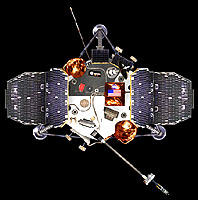
Pasadena (AFP) December 5, 1999 - A 10-minute window during which anxious scientists hoped to hear from the Mars Polar Lander closed Sunday without any signal from the spacecraft, officials here said. Faces were long in the tiny control room at NASA's Jet Propulsion Laboratory (JPL) when the communications team announced that only deafening silence had met the fifth opportunity to get in touch with the Lander, which was meant to search for underground water or ice on Mars. "We have not exhausted all the possibilities," project manager Richard Cook told a news conference Sunday. But he acknowledged that "the team is getting more frustrated and tense." "There are many different single faults possible," he said. But Cook also warned that if nothing happened by Tuesday, his team would be playing "overtime." The Mars Polar Lander and its two companion probes Deep Space Two have been incommunicado since late Friday, and four earlier windows opened and shut without any signal from the spacecraft. With only one more chance Sunday to hear from the Lander, project scientist Richard Zurek said "we'll be in a whole different ball game" if their efforts early in the day failed. Scientists thought the Lander's main antenna might not have been able to find Earth in earlier attempts, so on Sunday they had hoped it would use an alternate antenna with a broader range to contact a satellite in orbit around Mars since 1997. That satellite, the Mars Global Surveyor (MGS), could receive the signal and relay information back to Earth. But the window opened at 10:50 a.m. (1850 GMT) and closed 10 minutes later without the satellite relaying anything from the Lander. The MGS' relay radio "works perfectly well," said the relay's designer Jacques-Emile Blamont of France's National Center for Space Studies -- which means the problem is with the Lander. "We need several days to go through all the contingencies. We are a little less than halfway through the contingencies," said Sam Thurman, flight operations manager for the mission. But if the attempt to use the alternative antenna Sunday does not work during a second window from 10:10 to 11:10 p.m. (0610 to 0710 GMT Monday), the likelihood of ultimate success in contacting the Lander will be substantially less, officials said. "That would be a complex situation but a strategy can be made to deal with it," said Chris Jones, one of the scientists working with the JPL team. Scientists were more pessimistic about the chances of successfully contacting the Deep Space Two probes, which should have shot out of the Lander as it approached the planet and bored into the ground to search for water beneath the surface. A new attempt to reach those probes was made Saturday, and scientists were still waiting for the results of that effort Sunday. But Sarah Gavit, charged with the Scott and Amundsen probes, said there's a 50 percent chance the they landed either in a crater or on the edges of one, making it difficult to contact the Surveyor satellite when it passes overhead. Another possibility is that the probes never separated from the main Lander spacecraft, said Thurman. Scientists at the JPL had hoped the 165-million-dollar Polar Lander would signal that it had safely landed Friday near the Martian South Pole, but neither the Lander nor its probes have signalled Earth. Another scenario is that the computer on Polar Lander sensed a technical problem and shut down around 20 minutes after landing Friday, officials said. NASA scientists said they were all the more baffled by the glitch because things had been going so well until contact was lost. Until the cause of the malfunction is sorted out, engineers on Sunday continued to listen round-the-clock for the Lander's faint radio signal, which could be picked up by any of three antennas in California, Australia or Spain. Copyright 1999 AFP. All rights reserved. The material on this page is provided by AFP and may not be published, broadcast, rewritten or redistributed.
Email This Article Comment On This Article Related Links Space
 Satellite Launch To Boost DTH In India
 Calcutta, India (SPX) Dec 28, 2005
The successful launch Thursday of India's heaviest satellite from spaceport of Kourou in French Guyana may have boosted the country's space research efforts to yet another level, but it has also lifted the spirits of at least three Direct-To-Home televisions broadcasters, one of which has been waiting for years to launch its services in India. |
|
|

|
|
|
|
|
|
|
|
|
|
|
|
| The content herein, unless otherwise known to be public domain, are Copyright 1995-2006 - SpaceDaily.AFP and UPI Wire Stories are copyright Agence France-Presse and United Press International. ESA PortalReports are copyright European Space Agency. All NASA sourced material is public domain. Additionalcopyrights may apply in whole or part to other bona fide parties. Advertising does not imply endorsement,agreement or approval of any opinions, statements or information provided by SpaceDaily on any Web page published or hosted by SpaceDaily. Privacy Statement |