|
 |
 |
 |
 |
 |
 |
 |
 |

 |
Significant Milestone For Columbus Flight Readiness
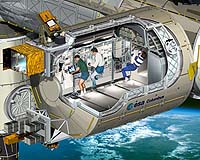
Paris, France (ESA) Jan 23, 2007 In December 2006, experts from ESA and partner organisations met to review Columbus launch preparations. The successful review was a significant milestone for the launch of the Agency's science module, planned for later this year. The review meeting, known formally as the Flight Operations Readiness Review, included experts from ESA, NASA, the German Aerospace Agency (DLR), the Japanese space agency (JAXA) and industry, and concluded that ESA and its partners are on track for the launch of the Columbus scientific laboratory. Columbus is Europe's cornerstone contribution to the International Space Station (ISS), and is scheduled for launch on shuttle mission STS-122 in October/November 2007. The Flight Operations Readiness Review was held 4-5 December 2006 at the Columbus Control Centre at Oberpfaffenhofen, near Munich, to review the state of preparation of the mission teams and ground infrastructure; it is a formal step required by NASA to check the state of readiness of its international partners in joint missions. Ground facilities established for Columbus were recently used during the 171-day Astrolab mission, completed by ESA Astronaut Thomas Reiter, of Germany, in December. Europe's ground preparations on track The review showed that ESA and partner preparations are on track and that the engineering, infrastructure and training tasks remaining to be done can be completed as planned prior to launch. The two-day review was a thorough and comprehensive review of readiness and looked at all areas related to the launch and start of operations for Columbus. The Columbus Control Centre is operated by DLR under contract from ESA. Review topics included NASA Shuttle flight planning status, payload operations, Columbus generic flight rules, shared documentation, Columbus Control Centre status, ground controller training and certification, flight crew training and the status of the USOCs, Europe's User Support and Operation Centres. These are located at the institutes and universities that will receive and analyse data returned from experiments onboard Columbus. Columbus Control Centre ready to control ESA's readiness to support the Columbus delivery mission 24 hours per day via the Columbus Control Centre was one of the key points examined during the review. Bob Chesson, Head of ESA's Human Spaceflight and Exploration Operations department and a review participant, said that formal qualification and acceptance of the Columbus Control Centre are complete, confirming that the ground infrastructure is in good shape. "We have completed a full programme of system validation tests with the Columbus module demonstrating that the mission control systems can talk to the spacecraft; at this time we have not identified any issues that could change this encouraging status," he added. Chesson also said that, as a result of this review, "We have shown that the operations facilities and teams are on schedule to achieve operational readiness in time for launch." His colleague, Roland Luettgens, Operations Manager for Columbus, added that the Columbus flight control team is currently undergoing their certification for the Columbus flight. "They are a highly motivated team of engineers and experts who will conduct the 13-day mission together with their counterparts at NASA." ESA astronauts ready for demanding Columbus delivery mission ESA astronauts Hans Schlegel, from Germany, and Leopold Eyharts, from France, are two of the key participants in the Columbus delivery mission, coded as "ISS Assembly Flight 1E." "ESA astronaut Hans Schlegel will be trained on all aspects of the 1E mission, and will serve as an EVA (spacewalk) crew member, while Leopold Eyharts will fly the 1E stage, receive all of the Columbus training and will be the overall lead for the mechanical and outfitting tasks," said Michel Tognini, Head of ESA's Astronaut Centre. Columbus activity ramps up In upcoming months, activity related to the launch of Columbus will intensify. The module itself has already been shipped to NASA's Kennedy Space Center, arriving in Florida on 30 May 2006 via an Airbus A300-600 'Beluga' heavy lift aircraft. In March and April 2007, ESA and NASA technicians aided by contractor personnel will begin removing Columbus from temporary storage. ESA's single biggest ISS contribution The Columbus laboratory is ESA's biggest single contribution to the International Space Station. The 4.5-metre diameter cylindrical module is equipped with flexible research facilities that offer extensive science capabilities. During its 10-year projected life span, Earth-based researchers - sometimes with a little help from the ISS crew - will be able to conduct thousands of experiments in life sciences, materials science, fluid physics and a host of other disciplines, all in the weightlessness of orbit. Community Email This Article Comment On This Article Related Links Astrolab Mission German Aerospace Center (DLR) Space Station News at Space-Travel.Com Space Station News at Space-Travel.Com
 M-59 Drops Off The Shopping
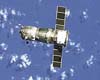 Korolev, Russia (SPX) Jan 23, 2007
Following a two-day free flight in a near-earth orbit cargo transport vehicle Progress M-59, launched from Baikonur launch site on January 18, 2007, docked to the International Space Station (ISS). The vehicle rendezvous with the ISS, its fly-about, station-keeping and birthing were performed in the automatic mode. |
|
|

| The content herein, unless otherwise known to be public domain, are Copyright 1995-2006 - SpaceDaily.AFP and UPI Wire Stories are copyright Agence France-Presse and United Press International. ESA PortalReports are copyright European Space Agency. All NASA sourced material is public domain. Additionalcopyrights may apply in whole or part to other bona fide parties. Advertising does not imply endorsement,agreement or approval of any opinions, statements or information provided by SpaceDaily on any Web page published or hosted by SpaceDaily. Privacy Statement |