|
 |
 |
 |
 |
 |
 |
 |
 |

 |
Siberia, The Big Bang of Life?
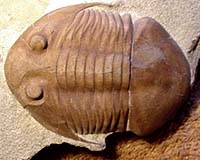
Gainesville FL - Apr 13, 2004 Trilobites, the primitive shelled creatures considered by many to be among the first animals to appear in the fossil record, may have originated in a place known today largely for its barren lifelessness: Siberia. The finding is one of the conclusions of a two year study by geologists at the University of Florida and University of Kansas that is scheduled to appear next week in the online edition of the London Journal of the Geological Society. By comparing separate, seemingly unrelated findings on trilobite evolution and geological history, UF's Joe Meert and KU's Bruce Lieberman concluded that precursors to modern continents began splitting off from a giant supercontinent at the South Pole about 580 million years ago, migrating north toward the equator for about 80 million years. The scientists' analysis suggests that a prominent theory holding that the continents moved far more rapidly is wrong. It also suggests that trilobites, the long-ago forbearers of crabs and lobsters, originated in present-day Siberia when it was a separate continent from Asia and located much farther south. Trilobites probably evolved in Siberia millions of years before they appear in the fossil record, the analysis suggests. In Lieberman's words, their appearance may have supplied the "fuse" for the Cambrian radiation, the "big bang" of life that occurred about 543 million years ago. "Siberia at the time -- it wasn't as cold and desolate place as it is today," Meert said. "It was in a better place (in the Southern hemisphere) but it's interesting that you can trace roots back." The study is the fruit of a chance meeting that happened in spring of 2001. Meert was visiting KU to present his research. In what Meert called a "Reese's chocolate-and-peanut-butter moment," the geologists compared notes and realized they had come to the same conclusions about the origins and movement of the modern continents using vastly different methods - one based on the magnetic properties of rocks, the other based on the evolution of trilobites. When rocks are formed, their magnetic minerals align to the earth's magnetic field, providing Meert the clues he needed to plot the original locations of his specimens on a globe. Carbon dating of radioactive minerals in the rocks also revealed when they were formed. By combining the formation dates with the location data, Meert deduced the whereabouts of the continents over the ages. Lieberman's research, by contrast, focused on using fossil records to study the evolutionary patterns of early life in insects and crustaceans, especially trilobites - the heavily armored, once-common arthropods that left millions of fossils around the globe before their extinction 250 million years ago. These patterns then pointed toward a likely continental breakup and drift scenario. Working independently, the UF and KU geologists each determined that the southern supercontinent began breaking up around 580 million years ago. The separate continents drifted northward toward the equator at about six inches per year, with this relatively rapid movement ending about 500 million years ago, they found. Meert's conclusions were based on research on dozens of rocks from locations ranging from Norway to Kenya to Madagascar. Lieberman drew his findings from comparisons of the physical characteristics, such as the number of body segments, of thousands of fossilized trilobites from different continents listed in a KU computer database. By grouping those with similar characters together, he determined where different groups originated and how closely related they were. While six inches is fast by comparison to today's continental movement of speed of one to two inches per year, it is far slower than that proposed by another prominent theory on early continental movement. That theory, known to scientists as "inertial interchange true polar wander," held the continents rotated from the South Pole to the equator in a mere 15 million years from 523 million to 505 million years ago - meaning they moved at more than 25 inches per year - more than four times faster than what Lieberman and Meert found. If that were true, Meert said, the expectation would be that all trilobites would be related in the same way - in other words, that their family tree would resemble a bush, with many closely related families together. In fact, some are much more closely related than others, which suggests they split off from and spent differing amounts of time apart from each other, Lieberman said. The analysis also suggests the first trilobite originated on Siberia several million years before the first fossil record of the animals appears. Both studies and methods resulted in the same outcome. "He had trilobites on my paleogeography and I had palegeography on his trilobites," Meert said. Although the cause of the Cambrian radiation remains unknown, the continents' movement away from one another opened a new ocean between them and probably warmed the climate, creating an atmosphere more conducive to life, Meert added. Community Email This Article Comment On This Article Related Links University of Florida SpaceDaily Search SpaceDaily Subscribe To SpaceDaily Express Explore The Early Earth at TerraDaily.com
 Oxygen in Ancient Atmosphere Rose Gradually To Modern Levels
 College Park MD (SPX) Dec 03, 2005
The history of life on Earth is closely linked to the appearance of oxygen in the atmosphere. The current scientific consensus holds that significant amounts of oxygen first appeared in Earth's atmosphere some 2.4 billion years ago, with a second large increase in atmospheric oxygen occurring much later, perhaps around 600 million years ago. |
|
|

| The content herein, unless otherwise known to be public domain, are Copyright 1995-2006 - SpaceDaily.AFP and UPI Wire Stories are copyright Agence France-Presse and United Press International. ESA PortalReports are copyright European Space Agency. All NASA sourced material is public domain. Additionalcopyrights may apply in whole or part to other bona fide parties. Advertising does not imply endorsement,agreement or approval of any opinions, statements or information provided by SpaceDaily on any Web page published or hosted by SpaceDaily. Privacy Statement |