|
 |
 |
 |
 |
 |
 |
 |
 |

 |
Shuttle returns safely to Earth
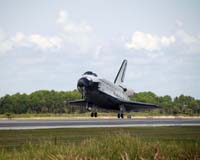
Cape Canaveral, Florida (AFP) Nov 7, 2007 The US Space Shuttle Discovery landed back on Earth on Wednesday at the end of an ambitious mission to extend the International Space Station. The shuttle, with its seven-strong crew, landed on schedule at 13:01 (1801 GMT) at the Kennedy Space Center in Florida after its mission lasting 15 days, two hours and 23 minutes. The five men and two women aboard Discovery, including Italian astronaut Paulo Nespoli, spent a total of 11 days on the ISS on a complex mission to expand the space station, which is key to US dreams of launching a manned missions to Mars. During its descent back to Earth the shuttle crossed the United States from the northwest down to the southeast in Florida, ahead of its landing on the Cape Canaveral runway on the Atlantic coast. NASA officials earlier reported no damage to Discovery's crucial insulation to endanger the ship during its descent, which made a text-book landing. Early Wednesday the crew were awakened by mission control in Houston, Texas with the title song from the children's hit musical "Chitty Chitty Bang Bang." "Good morning Discovery, and good morning Pam and thank you so much for that great wake-up music," Shannon Lucid in Houston said earlier, after the seven astronauts were roused at 0738 GMT. The song comes from the 1969 movie -- later a Broadway musical -- of the same name, about a flying old roadster that makes dreams come true. "Thanks Shannon, that's my favorite Sherman Brothers song," said Discovery commander Pamela Melroy. "We've got two beautiful wings ... and we are looking for a touchdown today." The Discovery had separated from the ISS early Monday after their mission which required a risky, unplanned spacewalk to repair damage to two solar arrays caused when they were unfurled on wings far out from the station. US astronaut Scott Parazynsky, a medical doctor by training, spent more than four hours on Saturday attached to the end of a robotic boom knitting together the damaged solar panels. Braving possible electrocution, Parazynsky used makeshift wire "cufflinks" to fix the tears caused by a snagged wire when the panels opened. Before heading back to Earth, the shuttle flew around the ISS so crew members could snap images of the repaired solar antenna to document the latest construction work to the orbiting outpost. On the mission, Discovery astronauts also delivered the Italian-built Harmony module, which will connect US, European and Japanese science labs on the ISS. Their work paves the way for the European Columbus science lab to be installed in the next shuttle mission in early December, and the Japanese Kibo lab, due to be delivered in early 2008. The ISS, a 100-billion-dollar (70.3-billion-euro) project involving 16 countries, is considered key to US ambitions to send a manned mission to Mars and is set to be complete within the next three years. The US space agency plans to launch at least another 11 missions to complete the ISS by 2010, when the shuttle fleet is scheduled to be taken out of service. The shuttle will be retired to make way for Constellation, a new space exploration project that aims to put humans back on the moon by 2020. Community Email This Article Comment On This Article Related Links Shuttle at NASA Watch NASA TV via Space.TV Space Shuttle News at Space-Travel.Com
 Good weather expected for shuttle landing Wednesday
 Cape Canaveral, Florida (AFP) Nov 6, 2007
Forecasters expect good weather Wednesday for the landing of the space shuttle Discovery after a 15 day trip to the International Space Station, NASA said Tuesday. |
|
|

| The content herein, unless otherwise known to be public domain, are Copyright 1995-2007 - SpaceDaily.AFP and UPI Wire Stories are copyright Agence France-Presse and United Press International. ESA Portal Reports are copyright European Space Agency. All NASA sourced material is public domain. Additional copyrights may apply in whole or part to other bona fide parties. Advertising does not imply endorsement,agreement or approval of any opinions, statements or information provided by SpaceDaily on any Web page published or hosted by SpaceDaily. Privacy Statement |