
 |
 |
 |
 |
 |
 |
 |
 |
 |

 |
Shuttle delivers Japanese lab to space station
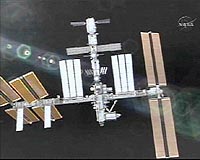
Washington (AFP) June 2, 2008 The US shuttle Discovery linked up smoothly with the International Space Station on Monday, delivering a bus-sized Japanese laboratory to expand research, and badly-needed parts for a troublesome toilet. After a two-day trip around Earth, Discovery docked with the orbiting station 338 kilometers (210 miles) above the south Pacific. Two hours later, the shuttle's seven astronauts floated into the ISS, where they exchanged hugs and handshakes with the outpost's three residents. "You have a beautiful house," US robotics specialist Greg Chamitoff told ISS crew member Garrett Reisman before the hatches opened. Chamitoff is replacing Reisman, who will return to Earth aboard Discovery after a three-month mission. About an hour before docking, Commander Mark Kelly steered Discovery into a rollercoaster-like maneuver, flipping the shuttle just 600 feet (180 meters) below the station to allow ISS astronauts to photograph its underside. The 360-degree maneuver, two days after the shuttle lifted off in Florida, has become a regular safety feature during flights allowing the space agency to ensure that the shuttle is free of potentially devastating damage. The images taken by the station crew members were downloaded to engineers on Earth who were inspecting them for signs of damage to the shuttle's thermal shield. Ground cameras spotted several pieces of foam coming off Discovery's external fuel tank during Saturday's launch from Cape Canaveral, Florida, but NASA has downplayed the risk posed by the debris. The National Aeronautics and Space Administration has meticulously scanned the shuttles' heat shields since the Columbia disaster in 2003, when a crack in its protective tiles led to its explosion, killing its seven astronauts. The Discovery team, which includes Japanese Aerospace Exploration Agency (JAXA) astronaut Akihiko Hoshide, will deliver and help install the second of three parts Japan's Kibo, or "hope," laboratory. Once in place, the 11.2-meter (36.7-foot) long, 14.8-tonne (32,600-pound) pressure module will be the single largest room on the ISS, with space for four scientists. Kibo's 10-meter (33-foot) robotic arm, which will manipulate materials and equipment for science experiments, will also be pulled from the shuttle and attached to the laboratory. "The Kibo module is ... just a beautiful piece of engineering," astronaut Michael Fossum, who will lead the spacewalks to install the Kibo lab, said Sunday. Two astronauts will step out of the station on Tuesday for a spacewalk to prepare the module for its removal from the shuttle's cargo bay on the same day. Three spacewalks are planned during the mission. The shuttle also brought parts to fix a high-tech Russian-built space toilet. The ISS commode malfunctioned last week, forcing the three ISS astronauts to rig up a still-troublesome bypass for liquid waste. Discovery is taking along a spare pump from Russia, which the two cosmonauts on the station are expected to install as soon as the shuttle arrives. Until the repair is complete, the three-member station crew will use the shuttle's toilet -- or they will use more emergency bags that Discovery is also bringing. Asked who would do the plumbing repair, Fossum said: "The fact is that the toilet is Russian hardware ... (but) if they need a hand and some wrenches we'll help out." Community Email This Article Comment On This Article Share This Article With Planet Earth
Related Links Shuttle at NASA Watch NASA TV via Space.TV Space Shuttle News at Space-Travel.Com
 Japan astronaut's fans celebrate shuttle launch
 Tokyo (AFP) June 1, 2008
Japanese space enthusiasts on Sunday celebrated the successful launch of the US shuttle Discovery, carrying the key unit of a Japanese research laboratory to the International Space Station. |
|
|

| The content herein, unless otherwise known to be public domain, are Copyright 1995-2007 - SpaceDaily.AFP and UPI Wire Stories are copyright Agence France-Presse and United Press International. ESA Portal Reports are copyright European Space Agency. All NASA sourced material is public domain. Additional copyrights may apply in whole or part to other bona fide parties. Advertising does not imply endorsement,agreement or approval of any opinions, statements or information provided by SpaceDaily on any Web page published or hosted by SpaceDaily. Privacy Statement |
 del.icio.us
 Digg
Digg Reddit
 YahooMyWeb
 Google
 Facebook