|
 |
 |
 |
 |
 |
 |
 |
 |

 |
Shuttle Spacewalk Restores Space Station's Steering Mechanism
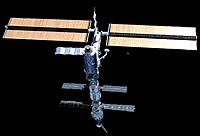
International Space Station (SPX) Aug 02, 2005 Two U.S. space shuttle astronauts went on another spacewalk to restore the steering gear on the International Space Station. Shuttle engineers, meanwhile, are debating whether to have the crewmen perform unprecedented and delicate maintenance on the shuttle's fragile heat shielding during the next spacewalk on Wednesday. U.S. astronaut Steve Robinson and Soichi Noguchi of Japan spent about seven hours in the frigid vacuum of space outside the shuttle Discovery. They replaced a failed space-station gyroscope, a rapidly spinning mechanism that helps the station maintain its stable position. They repaired another faulty gyro during their first outing Saturday. The loss of both units had left the station with only two working gyroscopes, the minimum needed to orient the outpost. The loss of a third would have required periodic firings of the station's steering jets to maintain stability, using precious fuel. Shuttle flight director Mark Ferring says the restoration of the two backups is a major accomplishment. "I think the biggest thing we have done on this mission for the space station is to make sure we have enough gyroscopes so we do not have to use our fuel to maintain our pointing on orbit," he said. "With such a massive vehicle, if we had to use fuel for that, we would only be able to go for a certain amount of months before we would run out of that resource." Now, there is one maintenance spacewalk left on Discovery's visit to the station. NASA is considering using much of the time to have the crewmen make unscheduled, emergency repairs to the heat shielding on Discovery's underside. Two thin slices of ceramic-coated fabric that fill the cracks between the shuttle's ceramic tiles are protruding two to three centimeters beyond the surface. NASA engineers say they could upset the smooth flow of air beneath the shuttle as it glides back toward Earth next week at speeds of 18 to 20 times the speed of sound. They believe that air turbulence created by these tiny projections could cause up to a 25 percent increase in already superheated temperatures at locations on the orbiter near them. Shuttle official Phil Engelauf says engineers are debating whether this would threaten the orbiter with a calamity like the one that befell the shuttle Columbia, which burned up during re-entry in 2003 because launch debris punctured a hole in its wing. "There are not a lot of vehicles that fly in the flight regime that the shuttle operates in," he said. "There is a fair amount of conservatism prevailing that until we can satisfy ourselves, maybe the better course of action is to go out and remove these, if that is the right thing to do. Again, that is getting discussed and debated." A spacewalk to repair the shuttle's surface would be unprecedented. It would require astronaut Steve Robinson to stand on the end of the robot arm underneath the shuttle, where no crewmember has ever been in orbit. NASA officials say if the decision is made to perform the task, they would take every precaution to ensure that his tool belt and tether line do not strike and damage Discovery's fragile ceramic barrier that protects it from the blistering heat of re-entry. Community Email This Article Comment On This Article Related Links SpaceDaily Search SpaceDaily Subscribe To SpaceDaily Express Space Station News at Space-Travel.Com
 NASA Had No Choice But To Buy Soyuz Flights
 Washington DC (SPX) Jan 09, 2006
NASA's announcement last week that it will pay Roskosmos $43.6 million for a round-trip ride to the International Space Station this spring, and an equivalent figure for an as-yet-undetermined number of future flights to the station until 2012, represents the agency's acknowledgment that it had no alternative. |
|
|

| The content herein, unless otherwise known to be public domain, are Copyright 1995-2006 - SpaceDaily.AFP and UPI Wire Stories are copyright Agence France-Presse and United Press International. ESA PortalReports are copyright European Space Agency. All NASA sourced material is public domain. Additionalcopyrights may apply in whole or part to other bona fide parties. Advertising does not imply endorsement,agreement or approval of any opinions, statements or information provided by SpaceDaily on any Web page published or hosted by SpaceDaily. Privacy Statement |