|
 |
 |
 |
 |
 |
 |
 |
 |

 |
Shuttle Should Service Hubble: NAS Report
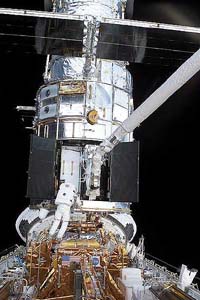
Washington DC (SPX) Dec 08, 2004 To ensure continuation of the extraordinary scientific output of the Hubble Space Telescope and to prepare for its eventual de-orbiting, NASA should send a space shuttle mission, not a robotic one, says a new congressionally requested report from the National Academies' National Research Council. The agency should consider launching the manned mission as early as possible after the space shuttle is deemed safe to fly again, because some of the telescope's components could degrade to the point where it would no longer be usable or could not be safely de-orbited, said the committee that wrote the report. "A shuttle servicing mission is the best option for extending the life of the Hubble telescope and ultimately de-orbiting it safely," said committee chair Louis J. Lanzerotti, distinguished research professor at the New Jersey Institute of Technology, Newark, and consultant, Bell Laboratories, Lucent Technologies, Murray Hill, N.J. "NASA's current planned robotic mission is significantly more technologically risky, so a robotic mission should be pursued only for the eventual removal of the Hubble telescope from orbit, not for an attempt to upgrade it. Also, a shuttle mission could be used to place equipment on the telescope to make a robotic de-orbiting mission more feasible." The Hubble telescope, which has operated continuously in orbit for the past 14 years, was designed to be serviced regularly by astronauts. Four servicing missions replaced nearly all the key components while increasing the telescope's capabilities. The fifth and final mission - to replace aging batteries, fine-guidance sensors, gyroscopes, and two scientific instruments - was originally intended to be completed by a shuttle crew as well, but NASA is currently planning an unmanned mission to service the telescope robotically. The committee's principal concerns about a robotic mission are the risk of failing to develop it in time and the risk of a mission failure, as well as the possibility that the robot could critically damage the telescope. A robotic mission would face significant challenges in using its grapple system to perform autonomous close-proximity maneuvers and the final capture of the space telescope - activities that have no precedent in the history of the space program and whose chances of success are low, according to the committee. "Our detailed analyses showed that the proposed robotic mission involves a level of complexity that is inconsistent with the current 39-month development schedule," said Lanzerotti. "The design of such a mission, as well as the immaturity of the technology involved and the inability to respond to unforeseen failures, make it highly unlikely that NASA will be able to extend the scientific lifetime of the telescope through robotic servicing." The committee assessed the safety risks of a shuttle servicing mission by comparing shuttle missions to the International Space Station - to which NASA plans to send 25 to 30 more shuttle flights - and shuttle missions to the Hubble telescope. The differences between the risks faced by the crew of a single shuttle mission to the space station and the risks faced by the crew of a mission to the Hubble telescope are very small, the committee concluded. Also, a shuttle crew would be able to successfully carry out unforeseen repairs to the Hubble telescope and develop innovative procedures for unexpected challenges in orbit, the report notes. Such contingencies have been successfully addressed on three of the four prior missions to the telescope. A robotic mission, on the other hand, might not be able to repair failures that it is not designed to address, possibly stalling the mission in its early stages. "With the replacement of aging components and the installation of new science instruments, Hubble is expected to generate as many new discoveries about stars, extra-solar planets, and the far reaches of the universe as it has already produced so far, with images 10 times more sensitive than ever before," Lanzerotti said. The study was sponsored by NASA. The National Research Council is the principal operating arm of the National Academy of Sciences and the National Academy of Engineering. It is a private, nonprofit institution that provides science and technology advice under a congressional charter. Community Email This Article Comment On This Article Related Links Assessment of Options for Extending the Life of the Hubble SpaceDaily Search SpaceDaily Subscribe To SpaceDaily Express Space Telescope News and Technology at Skynightly.com
 Carl Zeiss And Max Planck Researchers Develop Optical Technology For JWST
 Heidelberg, Germany (SPX) Dec 09, 2005
Carl Zeiss Optronics, in Oberkochen, Germany, and the Max Planck Institute for Astronomy in Heidelberg (MPIA), are developing the main fine mechanical optical technology for two instruments to be part of the James Webb Space Telescope (JWST).
--------------------------------------------------------- It's new. And it's downright terrific! Celestron's CPC Schmidt-Cassegrain telescope is the scope you've been waiting for! It offers new alignment technology, advanced engineering, and bold new design at a new, low price! In fact, Celestron's Professional Computerized (CPC) scope with revolutionary SkyAlign Alignment Technology redefines everything that amateur astronomers are looking for. It offers quick and simple alignment, GPS technology, unsurpassed optical quality, ease of use, advanced ergonomics, enhanced computerization and, most important, affordability. Want to view M-31 tonight? One button takes you there!
Shop for telescopes online at Telescopes.com! today!
|
|
|

| The content herein, unless otherwise known to be public domain, are Copyright 1995-2006 - SpaceDaily.AFP and UPI Wire Stories are copyright Agence France-Presse and United Press International. ESA PortalReports are copyright European Space Agency. All NASA sourced material is public domain. Additionalcopyrights may apply in whole or part to other bona fide parties. Advertising does not imply endorsement,agreement or approval of any opinions, statements or information provided by SpaceDaily on any Web page published or hosted by SpaceDaily. Privacy Statement |