|
 |
 |
 |
 |
 |
 |
 |
 |

 |
Shoulder Ligament A Linchpin In The Evolution Of Flight
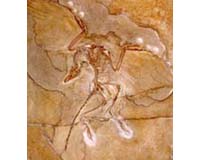
Providence RI (SPX) Dec 18, 2006 Brown and Harvard scientists have learned that a single ligament at the shoulder joint stabilizes the wings of birds during flight. In an advanced online publication of Nature, they explain how this tough bit of tissue evolved to become a linchpin for today's fliers. "How animals got off the ground - how limbs became wings - is a fascinating question," said team leader David Baier, a post-doctoral research fellow in the Department of Ecology and Evolutionary Biology at Brown. "What we learned here is that, in the evolutionary line to birds, a single ligament played an increasingly important role in flight." The team began with the pigeon. To better understand how the birds stabilized their wings during flight, they used CAT scans to make a 3D "virtual skeleton" and calculated the forces needed to maintain a gliding posture. They found that neither the shoulder socket nor the muscles could keep pigeon wings stable. The critical player, they found, is the acrocoracohumeral ligament, a short band of tissue that connects the humerus to the shoulder joint. The ligament balances all of the forces exerted on the shoulder joint - from the pull of the massive pectoralis muscle in the bird's breast to the push of wind under its wings - making it a linchpin for modern bird flight. To find out if this ligament played the same shoulder-stabilizing role in primitive animals, the team looked to the alligator. Alligators are close relatives of birds and both are archosaurs, the "ruling reptiles" that appeared on the planet some 250 million years ago and evolved into the dinosaurs that dominated during the Mesozoic Era. So to understand the sweep of evolution, the alligator was a great starting place. In the laboratory of Farish Jenkins Jr., a professor of biology and curator of vertebrate paleontology at Harvard University, the scientists put three alligators on motorized treadmills and took X-ray video. Baier and Brown evolutionary biologist Stephen Gatesy used the video to make a 3D computer animation that showed the precise positioning of the shoulder as the animal walked. They found that alligators use muscles - not ligaments - to do the hard work of supporting the shoulder. Then Baier hit the fossil record, studying the skeleton of Archaeopteryx lithographica, considered by many paleontologists to be the first bird. Baier even traveled to Beijing to examine the fossilized remains of Confuciusornis, Sinornithoides youngi and Sinornithosaurus millenii, close relatives of modern birds that were recently discovered in China. If the acrocoracohumeral ligament was critical to the origin of flight, Baier expected to find evidence of it in Archaeopteryx. Surprisingly, however, the new ligament-based force balance system appears to have evolved more gradually within Mesozoic fliers. "What this means is that there were refinements over time in the flight apparatus of birds," Baier said. "Our work also suggests that when early birds flew, they balanced their shoulders differently than birds do today. And so they could have flown differently. Some scientists think they glided down from trees or flapped off the ground. Our approach of looking at this force balance system can help us test these theories." Community Email This Article Comment On This Article Related Links Brown University Harvard University Aerospace News at SpaceMart.com Aerospace News at SpaceMart.com
 EU Compromises On Airlines In Carbon-Trading Scheme
 London (AFP) Dec 19, 2006
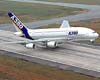
The European Commission has agreed to a compromise proposal over its plans to include the aviation industry in its carbon-trading scheme, the Financial Times reported on Tuesday. Citing an unidentified Commission official, the business daily said that the United States and Asian countries had reacted angrily to earlier proposals which would have seen airlines landing and taking off in the EU participate in the scheme. |
|
|

| The content herein, unless otherwise known to be public domain, are Copyright 1995-2006 - SpaceDaily.AFP and UPI Wire Stories are copyright Agence France-Presse and United Press International. ESA PortalReports are copyright European Space Agency. All NASA sourced material is public domain. Additionalcopyrights may apply in whole or part to other bona fide parties. Advertising does not imply endorsement,agreement or approval of any opinions, statements or information provided by SpaceDaily on any Web page published or hosted by SpaceDaily. Privacy Statement |