
 |
 |
 |
 |
 |
 |
 |
 |
 |

 |
Shipwrecks On Coral Reefs Harbor Unwanted Species
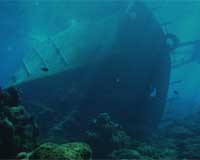
Washington DC (SPX) Aug 26, 2008 Shipwrecks on coral reefs may increase invasion of unwanted species, according to a recent U.S. Geological Survey study. These unwanted species can completely overtake the reef and eliminate all the native coral, dramatically decreasing the diversity of marine organisms on the reef. This study documents for the first time that a rapid change in the dominant biota on a coral reef is unambiguously associated with man-made structures. The findings of the study, published in the open-access journal PLoS ONE, suggest that removal of these structures sooner rather than later is key to keeping reefs healthy. In many areas of the world, coral reef health is declining, but identifying the exact cause of the problem is difficult. Overgrowth of coral reefs by other species, such as algae, are usually attributed to environmental degradation, but bleaching, disease, damage by typhoons, overfishing, coastal development, pollution, and tourism can cause problems as well. The study was conducted at Palmyra Atoll National Wildlife Refuge in the central Pacific, a relatively remote, comparatively pristine area where little human activity has occurred since WWII. In 1991, a 100-foot vessel shipwrecked on the atoll. Scientists first surveyed the area in 2004 and found a species called Rhodactis howesii -an organism related to sea anemones and corals-in low abundance around the wreck. In subsequent years, however, populations of this organism increased exponentially. Scientists documented extremely high densities of R. howesii that progressively decreased with distance from the ship, whereas R. howesii were rare to absent in other parts of the atoll. They also confirmed high densities of R. howesii around several buoys. Whether this phenomenon occurs on other coral atolls is unknown; however, in the case of Palmyra, the R. howesii infestation is beginning to reach catastrophic proportions, according to Dr. Thierry Work, the lead author of the study and a scientist at the USGS National Wildlife Health Center, Honolulu Field Station. Within a few years, R. howesii spread to where it now occupies nearly 1 square mile. "Why this phenomenon is occurring remains a mystery," said Work. One possibility, he said, is that iron leaching from the ship and mooring buoy chains, accompanied with other environmental factors particular to Palmyra atoll, are somehow promoting the growth of Rhodactis. "Given the ability of Rhodactis sp. to rapidly reproduce and completely smother reefs, managers are now facing the possibility that even with removal of the ship, sheer reproductive capacity of R. howesii may continue to fuel its spread along the western reef shelf of Palmyra," Work said. Understanding what constitutes a healthy underwater ecosystem, as well as what does not, is crucial to preventing further losses in species and habitat. This research illustrates a little-known problem that, unlike global warming and pollution, could be prevented by removing man-made debris such as shipwrecks from coral reefs before organisms like Rhodactis howesii can overtake healthy coral reefs. Community Email This Article Comment On This Article Share This Article With Planet Earth
Related Links Phase Shift from a Coral to a Corallimorph-Dominated Reef Associated with a Shipwreck on Palmyra Atoll Public Library of Science Darwin Today At TerraDaily.com
 Genome Of Simplest Animal Reveals Ancient Lineage
 Walnut Creek CA (SPX) Aug 25, 2008
As Aesop said, appearances are deceiving-even in life's tiniest critters. From first detection in the 1880s, clinging to the sides of an aquarium, to its recent characterization by the U.S. Department of Energy Joint Genome Institute (DOE JGI), a simple and primitive animal, Trichoplax adhaerens, appears to harbor a far more complex suite of capabilities than meets the eye. |
|
|

| The content herein, unless otherwise known to be public domain, are Copyright 1995-2007 - SpaceDaily.AFP and UPI Wire Stories are copyright Agence France-Presse and United Press International. ESA Portal Reports are copyright European Space Agency. All NASA sourced material is public domain. Additional copyrights may apply in whole or part to other bona fide parties. Advertising does not imply endorsement,agreement or approval of any opinions, statements or information provided by SpaceDaily on any Web page published or hosted by SpaceDaily. Privacy Statement |
 del.icio.us
 Digg
Digg Reddit
 YahooMyWeb
 Google
 Facebook