|
 |
 |
 |
 |
 |
 |
 |
 |

 |
Shepherding The Lightweight World
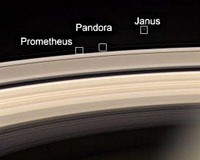
Moffett Field CA (SPX) Aug 25, 2004 Saturn is the only planet less dense than water (about 30 percent less). In the unlikely event that a large enough ocean could be found, Saturn would float in it. Viewing this strange world up close, one's picture of how a planet should behave- with a solid surface and - has to be turned upside down. Given that the mass of Saturn is water buoyant, it should come as no surprise that where water is detected, it must be off-world. With more stunning images, the Cassini spacecraft continues to highlight the icy debris of Saturn's wispy rings along with its icy satellites. Apparently, anything to do with water on Saturn appears far away from this lightweight world. Like Jupiter, the action on Saturn is mainly in the atmosphere. Near the equator, easterly windspeeds reach velocities of 500 meters a second (1,100 miles an hour). Both Jupiter and Saturn show stormy bands of gas turbulence and charged clouds. The longitudinal bands provide rotating stripes that span the planet's circumference in parallel slices only occasionally breaking up into swirls and vortices that must dwarf the most violent tornadoes and hurricanes imagined elsewhere in the solar system. Saturn and its rings are prominently shown in the right color image, along with three of Saturn's smaller moons. These rings may be composed of icebergs and/or snowballs from a few centimeters to a few meters in size. From left to right, three of the moons shaping these rings are Prometheus, Pandora and Janus. Prometheus and Pandora are often called the "F ring shepherds" as they control and interact with Saturn's interesting F ring, seen between them. By sandwiching two sides of the narrow F ring, these two moons shape it gravitationally and also give rise to many curious braid-like bands. Prometheus orbits inside the ring and Pandora orbits outside the ring herding it into shape. As a milestone for marrying theoretical and observational astronomy, scientists predicted that an undiscovered ring might be formed here, and only in 1980 was their "F-ring" hypothesis confirmed by Voyager I during its Saturn flyby. The spacecraft's namesake, Giovanni Cassini, observed the most prominent of the known divisions among the rings (prominent between A and B rings) in 1675, which previously had gone unresolved with the telescopes dating back to Galileo's time. The Cassini division is kept free of dusty material because of gravitational interactions with the moon Mimas. Any debris at this distance from Saturn orbits twice as fast as Mimas, which consequently tugs enough to clear a resonant gap, or clear path, by pulling material between A and B rings. The lettering scheme, "A through F", refers to the historical order of the ring divisions' discoveries, and does not relate easily to their distance from Saturn. In the case of the thin F and G rings, the last discovered gaps, these debris fields do lie outside the more prominent "A through D" system. This F-ring image was taken on June 18, 2004, with the Cassini spacecraft narrow angle camera 8.2 million kilometers (5.1 million miles) from Saturn. With just a bit of detail visible on its lit hemisphere, Saturn's moon Tethys was imaged (not shown in this article) by Cassini on July 20, 2004. A round feature, likely a large crater, can be seen near the boundary where day and night meet, at the bottom of the image. Dark markings are visible near the top. Tethys' surface temperature is -187� C (-305� F). It would take about 12 copies of Tethys to span the Earth's equator, since its radius is about eight percent of our own planet's. A mission goal for Cassini is to determine the composition of moons like Tethys and Prometheus, along with most of the other 33 satellites, many of which appear to have an icy crust. Condensed ices give the moons very high albedo (reflection coefficients) but are mottled with darker regions that may be rich in organic chemicals like methane or ammonia. These building blocks for primitive biochemistry may offer insight into how a similar, but much warmer environment on Earth, might have given rise to primordial life. Also largely unknown about the moons is their internal core composition and if they have conducting cores, how these might interact with Saturn's charged magnetosphere. Saturn's mainly hydrogen composition drives convection and some ill-understood magnetic properties. Unlike Jupiter, Saturn does not generate radio waves detectable on Earth -a result that contrasts with the powerful magnetic environment of its gas giant neighbor, Jupiter. Not until 1979 and the flyby of Pioneer 11, was it known if Saturn even had a magnetic field at all. The image of Tethys was taken in visible light, with the Cassini spacecraft narrow angle camera from a distance of 6.1 million kilometers (3.8 million miles) from Tethys, and at a Sun-Tethys-spacecraft, or phase angle of 92 degrees. The image scale is 37 kilometers (23 miles) per pixel. Community Email This Article Comment On This Article Related Links Cassini at JPL Cassini Image Team SpaceDaily Search SpaceDaily Subscribe To SpaceDaily Express Explore The Ring World of Saturn and her moons Jupiter and its Moons The million outer planets of a star called Sol News Flash at Mercury
 Cassini Images Halo Around Titanic Moon Off Saturn
 Pasadena CA (SPX) Dec 27, 2005
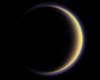
With its thick, distended atmosphere, Titan's orange globe shines softly, encircled by a thin halo of purple light-scattering haze. |
|
|

| The content herein, unless otherwise known to be public domain, are Copyright 1995-2006 - SpaceDaily.AFP and UPI Wire Stories are copyright Agence France-Presse and United Press International. ESA PortalReports are copyright European Space Agency. All NASA sourced material is public domain. Additionalcopyrights may apply in whole or part to other bona fide parties. Advertising does not imply endorsement,agreement or approval of any opinions, statements or information provided by SpaceDaily on any Web page published or hosted by SpaceDaily. Privacy Statement |