|
 |
 |
 |
 |
 |
 |
 |
 |

 |
Shenzhou's Changing Face
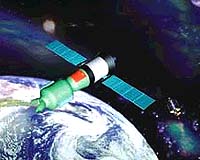
Sydney - Mar 3, 2003 As China reinforces its goal of launching its first astronauts before the end of the year, it's time to look at another mystery surrounding China's Shenzhou spacecraft. Analysts have long wondered about the structures at the front end of the Shenzhou orbital module. Most images and models of the spacecraft show a complex arrangement of experimental packages that's probably flown on all of the missions to date. But Shenzhou can't stay this way forever. The spacecraft will eventually need a docking apparatus, but China has been reluctant to supply details on this. China has stated in the past that Shenzhou will feature an "international" docking system, but this statement is as vague as most technical commentaries on the spacecraft. China may have bought Russian docking systems, which could be copied and manufactured locally. It could be the case that China simply hasn't finalised its plans for a docking system yet. The first crewed mission won't need one, and China may not be planning any sort of rendezvous and docking for a few missions afterwards. One curious piece of evidence has come in the form of an image published last year by People's Daily, and reproduced previously by SpaceDaily. This photograph shows a simplistic model of Shenzhou with a space backdrop. The model appears to be smaller and less detailed that some of the other replicas China has released of this spacecraft, but has a curious difference. It seems to have a docking system at its front. Two arm-like protrusions at the front of the orbital module could be capture devices, designed to grab another spacecraft like pincers. It's certainly possible to build a docking system this way, but the design is nothing like anything that has previously flown in space. Is this our first true glance at Shenzhou's docking system? Maybe, maybe not. It's possible that the model is nothing more than an engineering mockup of an earlier proposal for Shenzhou, featuring a docking system that will never appear on the real spacecraft. The model could have been used to produce stock images of Shenzhou for a photo library. The pincers could be designed to capture smaller satellites without regular docking systems, and allow inspection through a window in the front of the orbital module. Astronauts could even perform EVA to work on any objects held by the pincers. Probably the most detailed evidence of Shenzhou's intended docking system appeared early this year, when China released images of a prototype space laboratory. This cylindrical module (previously covered by SpaceDaily) is reminiscent of the European Spacelab module that made several trips to orbit in the space shuttle's payload bay. It also strongly resembles the Shenzhou orbital module in its size and shape. The overall design of this module is unsurprising, but the most interesting element in the photograph is the docking system at its front. It's an androgynous docking unit, sporting three inward-tilted petals. The docking system is strongly reminiscent of those used on the International Space Station. Some analysts have speculated that the docking system is a direct copy of such a device, but the photography doesn't provide enough evidence to reach a definite conclusion. This photograph does not depict Shenzhou, but the space laboratory would certainly be designed to operate with a Shenzhou spacecraft. Thus, we can speculate that the docking system on the module would be compatible, and presumably identical, to the one on Shenzhou. The use of an androgynous docking system, based on an existing design, would save time and money. It would also pave the way for Shenzhou to dock with the International Space Station, and even allow Chinese modules to be attached to the station. When the Shenzhou program made its debut, such plans seemed quite remote, given the state of relations between China and the USA. But politics on Earth are very fluid at the present, and the fate of the International Space Station itself is under close examination, following the tragic loss of the shuttle Columbia. As with the Russian Soyuz spacecraft, the design of Shenzhou allows just about anything to be placed at the front of the orbital module. Soyuz has been flown with crude latching docking systems that did not even allow hatches to be opened between vehicles, traditional drogue docking systems and androgynous docking systems. It has also been flown with cameras and other scientific instruments at the front of the orbital module. Shenzhou could also end up carrying a variety of payloads on its orbital module. The scientific instrument package that we have seen in the past could fly again, but Shenzhou could also carry docking systems of various forms, or even remote manipulators. It remains to be seen just what China will come up with in the future. Dr Morris Jones is a Sydney-based journalist and University lecturer. Email morrisjonesNOSPAMhotmail.com. Replace NOSPAM with @ to send email. Community Email This Article Comment On This Article Related Links SpaceDaily Search SpaceDaily Subscribe To SpaceDaily Express The Chinese Space Program - News, Policy and Technology China News from SinoDaily.com
 Taikonauts On Moon A Far Off Dream For China Yet
 Beijing (XNA) Jan 05, 2006
A one-year lunar fly-by mission may start in April 2007 in China, but a manned flight to the Earth's neighbour may be a long way away, a chief lunar exploration scientist said last night. |
|
|

| The content herein, unless otherwise known to be public domain, are Copyright 1995-2006 - SpaceDaily.AFP and UPI Wire Stories are copyright Agence France-Presse and United Press International. ESA PortalReports are copyright European Space Agency. All NASA sourced material is public domain. Additionalcopyrights may apply in whole or part to other bona fide parties. Advertising does not imply endorsement,agreement or approval of any opinions, statements or information provided by SpaceDaily on any Web page published or hosted by SpaceDaily. Privacy Statement |