
 |
 |
 |
 |
 |
 |
 |
 |
 |

 |
Shenzhou 7 Is Not A Space Station
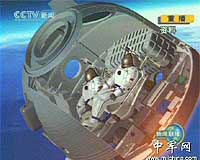
Sydney, Australia (SPX) Sep 22, 2008 Some strange reportage about the Shenzhou 7 space mission has leaked out of China recently. News outlets around the world have carried the story, claiming that the Shenzhou 7 mission is the start of China"s space station assembly. The story claims that part of the Shenzhou 7 spacecraft will dock with other modules to form a space station. Nothing could be further from the truth. This is an exciting mission, featuring China"s first spacewalk, but it is not a space station flight. The Shenzhou spacecraft features a large cylindrical cabin at its front, known as the Orbital Module, that gives the crew extra room. On the Shenzhou 7 mission, the astronauts will use this module as an airlock for leaving the spacecraft. At the end of the Shenzhou 7 mission, this module will be discarded from the spacecraft. The rest of the spacecraft will then enter the atmosphere following a retrorocket burn, returning the crew to Earth. But the Orbital Module is not destined for any further missions. Lacking a docking system or solar panels, it will simply orbit the Earth as space junk for a few weeks. It will soon burn up in the atmosphere. After this, no part of the Shenzhou 7 spacecraft will still be in space. The next sequence of Shenzhou missions are expected to start China"s space station work. This will start with the launch of a small "space laboratory" module dubbed Shenzhou 8 that does not resemble a conventional Shenzhou spacecraft. The laboratory consists of two joined cylinders, one slightly wider than the other, with two docking ports and a pair of solar panels. An unmanned Shenzhou capsule spacecraft, dubbed Shenzhou 9, will be launched to dock with the laboratory. Finally, the Shenzhou 10 spacecraft will be launched. This will carry three astronauts to a docking with the Shenzhou 8 and 9 spacecraft in orbit. The three spacecraft, linked together, will form a small space station complex. The missions will probably fly in 2010, although some reports now point to a 2009 launch date for the first. What caused the confusion? It"s probably a case of sloppy reporting, and the misinterpretation of a source. Somebody has confused the two distinct mission sequences. In the future, however, it is entirely possible that some Shenzhou spacecraft will add their Orbital Modules to a more advanced space station. Shenzhou spacecraft could dock with a space station, then detach the rest of the spacecraft from the Orbital Module before flying away from the station. The remaining two modules, the Descent Module and Instrument Module, are all that is needed to return a crew to Earth. Only the Descent Module returns to Earth safely. The space station could progressively grow in size as each subsequent crew arrives and departs. The Orbital Modules are not very large, but a collection of them would provide ample room for a space station crew and their gear. It should be noted, however, that no such activity has been mentioned in connection with the Shenzhou 8-9-10 mission complex. We will see what happens in the future. Dr Morris Jones is the author of "When Men Walked on the Moon" and "The Adventure of Mars". Email morrisjonesNOSPAMhotmail.com. Replace NOSPAM with @ to send email. Dr Jones is available for media interviews. Community Email This Article Comment On This Article Share This Article With Planet Earth
Related Links The Chinese Space Program - News, Policy and Technology China News from SinoDaily.com
 China's Shenzhou-7 In Final Preparation For Launch
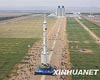 Jiuquan, China (XNA) Sep 22, 2008
The Shenzhou-7 manned spaceship, the Long-March II-F rocket and the escape tower were vertically transferred to the launch pad at 3:15 p.m. on Saturday, marking the final stage of the preparation. |
|
|

| The content herein, unless otherwise known to be public domain, are Copyright 1995-2007 - SpaceDaily.AFP and UPI Wire Stories are copyright Agence France-Presse and United Press International. ESA Portal Reports are copyright European Space Agency. All NASA sourced material is public domain. Additional copyrights may apply in whole or part to other bona fide parties. Advertising does not imply endorsement,agreement or approval of any opinions, statements or information provided by SpaceDaily on any Web page published or hosted by SpaceDaily. Privacy Statement |
 del.icio.us
 Digg
Digg Reddit
 YahooMyWeb
 Google
 Facebook