|
 |
 |
 |
 |
 |
 |
 |
 |

 |
Shenzhou 6 Tab: US$111m
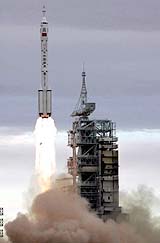
Beijing (XNA) Oct 18, 2005 China has spent 900 million yuan (US$111.2 million) on its successful second manned space mission and has great interest in launching commercial satellites for global clients, a senior official said. All the Shenzhou VI money is from the government, said Tang Xianming, director of the China Manned Space Engineering Office. He addressed a news conference at the State Council Information Office, about six hours after the return of the re-entry capsule. The craft carrying taikonauts Fei Junlong and Nie Haisheng ended its 115.5-hour space voyage and returned to Earth at 4:33am yesterday. The two taikonauts arrived in Beijing at 9:28am. Radiant and triumphant, Fei and Nie stepped down from the aircraft. Both were in good shape and excellent health when they arrived back on Earth after the spaceflight, the medical team said. The objectives of a flawless blast-off, a safe flight, preservation of the astronauts health and a safe return were all realized. Tang told the press that China has launched a foreign satellite this year and signed cooperative contracts on launching several other foreign satellites. He said US and French satellites had been launched but did not identify other nations. The successful Shenzhou VI mission marks the 88th launch and the 46th consecutive successful blast-off of China's Long March series rockets. Tang recalled the whole process of the successful piloted spaceflight, calling it a milestone for China's space program and a proof that the country is completely capable of carrying out its own independent space program. No problem had occurred during Shenzhou VI's flight, he said. At the briefing, Chinese and foreign reporters bombarded Tang and Xu Dazhe, deputy general manager of the China Aerospace Science and Technology Group, with questions on the space voyage and China's plans for its space program. According to Tang, Chinese taikonauts will undertake a space walk in 2007 and the country will also conduct rendezvous docking in orbit in 2009-12, while a moon-circling satellite is being developed. He disclosed that the main goal of China's manned space program is to build a permanent space station. All the 14 Chinese taikonauts in service have been trained in a microgravity environment in Russia, as part of China's efforts in international cooperation and exchanges in space technology, Tang said. He said China is considering selecting women taikonauts and will have women taikonauts in near future. According to Tang, China has sent US and French satellites into space with Chinese rockets from Chinese launch pads over the past years, winning appreciation and support of the international space circle. "We will continue international exchanges and cooperation in this field," Tang said. To carry out space exploration with a lunar probe will be the inevitable choice of the space program, said Xu. The lunar probe program will be accomplished in three steps, namely lunar orbiting, lunar landing and return from the moon, Xu said. "The corporation is participating in the research and development of the Chang'e-1 lunar probe and related launch vehicle," Xu said. He said "Development of Chang'e-1 lunar probe is now well under way as planned." Tang said the lunar probe program is mainly undertaken by the nation's aerospace agency, independent from the current manned space program.
Community
 Taikonauts On Moon A Far Off Dream For China Yet
 Beijing (XNA) Jan 05, 2006
A one-year lunar fly-by mission may start in April 2007 in China, but a manned flight to the Earth's neighbour may be a long way away, a chief lunar exploration scientist said last night. |
|
|

| The content herein, unless otherwise known to be public domain, are Copyright 1995-2006 - SpaceDaily.AFP and UPI Wire Stories are copyright Agence France-Presse and United Press International. ESA PortalReports are copyright European Space Agency. All NASA sourced material is public domain. Additionalcopyrights may apply in whole or part to other bona fide parties. Advertising does not imply endorsement,agreement or approval of any opinions, statements or information provided by SpaceDaily on any Web page published or hosted by SpaceDaily. Privacy Statement |