|
 |
 |
 |
 |
 |
 |
 |
 |

 |
Shenzhou 5's Ongoing Mission
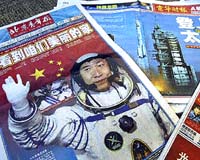
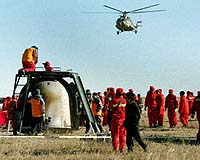
Sydney - Oct 16, 2003 The safe return to Earth of Yang Liwei has completed the most important goal of the Shenzhou 5 mission. China has launched an astronaut and returned him safely. From the images and comments released by Chinese news agencies, it would seem that Shenzhou 5 has enjoyed a flawless flight. Yang is obviously in good health and good spirits, which demonstrates much about the performance of the spacecraft during its orbital phase and its dangerous re-entry and descent phase. The speedy recovery of Yang also shows that its landing was within the expected zone. China can celebrate a successful mission for its first astronaut with complete justification, but the flight and assessment of Shenzhou 5 is still not entirely complete. There will be much analysis to be performed of data collected during the mission, both from telemetry during the flight and information collected from the returned capsule. Curiously, Chinese media reported that the Long March 2F launch vehicle ejected a "black box" into the ocean during its ascent, and that crews were searching for it. The box apparently records data that cannot be transmitted during the flight, but the reasons for this are ambiguous. It could be a question of bandwidth. Sensors on board the rocket could have recorded so much data that it could not be squeezed into the radio downlink during the rapid ascent phase. But it's also possible that the black box contains information that was considered too sensitive for open transmission. Data on the performance of the launch vehicle could have military implications, given the parallels between China's space launchers and its missile program. Yang almost certainly received a medical examination after his swift return to Beijing, but there is probably little to be learned from this. Doctors would probably certify that Yang was in good health and did not require any medical treatment. But a mission of short duration on board a properly functioning spacecraft is unlikely to produce any significant effects for medical research. There will also be analysis of the Shenzhou 5 descent capsule, but this will probably just confirm that its re-entry was within engineering tolerances. The capsule seems to be in very good condition, judging by photography released after landing. Shenzhou 5 also carried seeds in the descent capsule, but it's unlikely that any scientific discoveries will be recorded from monitoring their development. Their exposure to space has been very short and there were no major radiation anomalies or solar flares during the mission. So the radiation dose they received will be small.

|