|
 |
 |
 |
 |
 |
 |
 |
 |

 |
Shenzhou-5 Launch Preparation Forges Ahead Despite SARS Epidemic
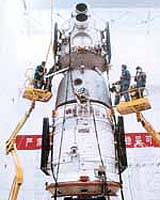
Hong Kong - May 16, 2003 China is forging ahead preparation of the historic manned space mission Shenzhou-5 despite the SARS (Severe Acute Respiratory Syndrome) medical crisis in many parts of the country. Wen Wei Po here reported last Thursday (May 8) that there was no stoppage of work due to the atypical pneumonia outbreak. Sources in the aerospace community in Beijing told the newspaper that "preparation work had been progressing nominally with no interference from external factors." The sources added that rumour of the cancellation of the launch due to the SARS outbreak and the recent submarine accident was "entirely a speculation from people who were not knowledgeable with inside information." The unidentified sources also said that in addition to the Shenzhou-5 flight (SZ-5, Shenzhou means "Magic Vessel" or "Divine Vessel"), China would aim to launch seven other satellites. Among the satellites that Chinese space officials have confirmed include the second spacecraft in the series of the China-Brazil collaborative remote sensing project Ziyuan-1B (Ziyuan means "resource"), the Beidou navigation satellite (Beidou means "Big Dipper"), and the ESA-China joint Double Star satellites that will study the solar-terrestrial relations. The other satellites belong to "new series whose identities cannot be revealed at this time," according to the unnamed sources. Later in the day the official Xinhua News Agency confirmed the Wen Wei Po story. Zhang Qingwei, General Manager of China Aerospace Science and Technology Corporation (CASC), told Xinhua that preparation of the SZ-5 spacecraft and the Changzheng-2F (Long March-2F) launcher were moving along smoothly. CASC has been heavily involved in the research and development of the Shenzhou capsule and the CZ-2F launch vehicle. Preparation of the SZ-5 flight started soon after the completion of the SZ-4 primary mission at the beginning of the year. Zhang said that technicians had been working on average over 10 hours a day and on additional shifts to prepare and test the SZ-5 mission components. Since the Chinese government finally acknowledged the outbreak of SARS in March, spacecraft and launcher test centres had been disinfected daily. All technicians and personnel had his/her body temperature measured and donned protective face masks before the start of the work shift. Test teams have also closely monitored the epidemic situation near the centres. Each centre would implement either a completely closed or a semi-closed management system based on the assessment to minimize personnel and materials contact with potential infectious sources. On the following day (May 9) General Directors and Chief Designers of the manned spaceflight program said at a joint meeting in Beijing that testing of the SZ-5 spacecraft would be carried out as planned. Meeting participants said that yuhangyuan ("astronaut") training was progressing steadily. They also said that preparation of the spacecraft application systems, and the systems for manned spaceflight launch centre, observation and control centre and landing centre continued according to plan. The leaders of the manned spaceflight project demanded all units to safeguard the health of frontline workers so as to guarantee the schedule of the manned space program. Beyond the news that the SZ-5 launch preparation is well underway, Chinese space officials have not discussed the timeline of the launch or how many yuhangyuans would ride on the historic flight. Media reports earlier this year suggested that the launch might take place in November or December. Wen Wei Po reported last Saturday (May 10) that SZ-5 could be launched earlier before the arrival of winter. Sources told the newspaper that if the launch preparation would go without any problem, the liftoff could very likely happen soon after the National Day celebration on October 1. A slightly earlier launch in the year would avoid the frigid winter weather that might affect launch processing, and take into consideration the safety of the yuhangyuans during training at the launch base, spacecraft ingress and landing at the end of the mission. Extreme cold weather had caused a one-day delay in the launch of SZ-4 late last year. The sources also said that the CZ-2F launcher for the SZ-5 mission would probably be delivered around September from Beijing to the Jiuquan Satellite Launch Centre (JSLC) in the northwestern Gansu Province. Since the upcoming SZ-5 flight would be a manned mission, workflow at the launch centre would need seven extra days than the previous four Shenzhou launches. Community Email This Article Comment On This Article Related Links SpaceDaily Search SpaceDaily Subscribe To SpaceDaily Express The Chinese Space Program - News, Policy and Technology China News from SinoDaily.com
 Taikonauts On Moon A Far Off Dream For China Yet
 Beijing (XNA) Jan 05, 2006
A one-year lunar fly-by mission may start in April 2007 in China, but a manned flight to the Earth's neighbour may be a long way away, a chief lunar exploration scientist said last night. |
|
|

| The content herein, unless otherwise known to be public domain, are Copyright 1995-2006 - SpaceDaily.AFP and UPI Wire Stories are copyright Agence France-Presse and United Press International. ESA PortalReports are copyright European Space Agency. All NASA sourced material is public domain. Additionalcopyrights may apply in whole or part to other bona fide parties. Advertising does not imply endorsement,agreement or approval of any opinions, statements or information provided by SpaceDaily on any Web page published or hosted by SpaceDaily. Privacy Statement |