|
 |
 |
 |
 |
 |
 |
 |
 |

 |
Shenzhou-4 Primary Mission To End On Sunday
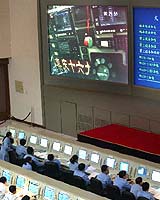
Beijing - Jan 04, 2003 The unmanned Shenzhou-4 mission is apparently operating free of problems midway through its planned 7-day flight. Mission controllers are aiming to end the primary mission with the landing of the Descent Module in the early evening on Sunday (Jan. 5) at the prime landing site in central Inner Mongolia. The mission update came from the third mission status report that the official Xinhua News Agency transmitted yesterday (Jan. 3). Qin Wenbo, Shenzhou spacecraft project Deputy Commander-in-Chief, confirmed the landing decision in a China News Services report on the same day. The Hong Kong-based newspaper Wen Wei Po reports today (Jan. 4) that weather at the prime landing site is favourable. According to the report the prime landing site is at the steppe about 40 km from Hohhot, the capital of the Nei Mongol (Inner Mongolia) Autonomous Region. After almost five days in space, Shenzhou-4 (SZ-4, Shenzhou means "Magic Vessel" or "Divine Vessel") is in an orbit of 330.9 x 337.0 km with an inclination of 42.4 deg and a period of 91.2 minutes. In the first mission status report that the Beijing Aerospace Command and Control Center (BACCC) issued on Tuesday (Dec. 31), mission control said that the spacecraft was functioning nominally after completing 29 orbits and the science experiments were proceeding smoothly. BACCC Director Xi Zheng said that under the central coordination of BACCC, all the land-based tracking stations and the four sea-based Yuanwang (YW, Yuanwang means "Long View") tracking ships were monitoring, observing and controlling SZ-4 continuously. After the successful liftoff at 40 minutes past midnight Beijing Time on Dec. 30 (16:40 UTC, Dec. 29) from the Jiuquan Satellite Launch Centre (JSLC) in the northwestern Gansu Province, the spacecraft reached the predetermined initial orbit of 200 x 343 km. With the solar arrays fully deployed, BACCC successfully commanded SZ-4 to circularize its orbit to the operational altitude of 343 km on orbit number 5. At BACCC the large displays at the front of the control room showed scenes of the SZ-4 interior and clear imagery of Earth. The imagery transmission is part of the test of the digital TV transmission system on SZ-4. In the afternoon of Dec. 31 Chief Commander of the Chinese manned space project and Minister of General Armament Department of the People's Liberation Army (PLA) Li Jinai, and Political Commissar of PLA General Armament Department Chi Wanchun visited BACCC to find out the conditions of the SZ-4 spacecraft. They were specifically concerned with the temperature inside the Descent Module, and the condition of the environment control and life protection systems. Both VIPs also conducted an air-to-ground audio communications test with the spacecraft. Then less than half a day later at 9 minutes after the arrival of the New Year, SZ-4 sent recorded greetings to mission control; the PLA Daily reported on Jan. 1. The greetings read: "Wishing people across the nation a happy New Year!" On the following day (Jan. 2) SZ-4 carried out one of the three planned orbit maneuvers to maintain its orbit, according to the second mission status report. At 8:40 p.m. Beijing Time (1240 UTC, Jan. 2) when SZ-4 approached the south Atlantic Ocean where the YW-3 tracking vessel stationed, BACCC sent the orbit maneuvering command through YW-3 to the spacecraft to fire its maneuvering thrusters for about 5 seconds. SZ-4 had completed 61 orbits when the maneuver took place. On one of the large displays at BACCC was an animation that showed the event. Shortly after YW-3 transmitted data to confirm the successful maneuver. In the latest mission status report, BACCC controllers declared that SZ-4 continued to operate well and all science experiments were running successfully. The report said that based on data returned from the spacecraft, such as the atmospheric pressure and composition in the Descent and Orbital Modules, all indices related to life support were nominal. Besides using the collected data, mission controllers also rely on visual imagery to monitor the environment inside the spacecraft. For example, the status report said that when SZ-4 passed through a ground observation and control zone, it would transmit an interior scene that includes a view of a suspended colour ball. If there were no air current flow inside the spacecraft, the ball would stay still. Otherwise the ball would move in the direction of the airflow. The status report also carried the announcement from the Chinese Academy of Sciences (CAS) Payload Operation and Application Centre (POAC) that scientists completed and achieved the objectives of the cell electrofusion and microgravity fluid physics experiments. With the completion of these experiments, scientists began microwave observations of the Earth. Community Email This Article Comment On This Article Related Links SpaceDaily Search SpaceDaily Subscribe To SpaceDaily Express The Chinese Space Program - News, Policy and Technology China News from SinoDaily.com
 Taikonauts On Moon A Far Off Dream For China Yet
 Beijing (XNA) Jan 05, 2006
A one-year lunar fly-by mission may start in April 2007 in China, but a manned flight to the Earth's neighbour may be a long way away, a chief lunar exploration scientist said last night. |
|
|

| The content herein, unless otherwise known to be public domain, are Copyright 1995-2006 - SpaceDaily.AFP and UPI Wire Stories are copyright Agence France-Presse and United Press International. ESA PortalReports are copyright European Space Agency. All NASA sourced material is public domain. Additionalcopyrights may apply in whole or part to other bona fide parties. Advertising does not imply endorsement,agreement or approval of any opinions, statements or information provided by SpaceDaily on any Web page published or hosted by SpaceDaily. Privacy Statement |