|
 |
 |
 |
 |
 |
 |
 |
 |

 |
Sharply Tuned Nanostrings Work at Room Temperature
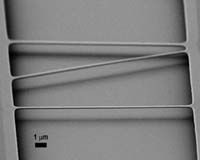
Ithaca NY (SPX) Jul 19, 2006 Using a fast, low-cost fabrication technique that allows inexpensive testing of a wide variety of materials, Cornell researchers have come up with nanoscale resonators - tiny vibrating strings - with the highest quality factor so far obtainable at room temperature for devices so small. The work is another step toward "laboratory on a chip" applications in which vibrating strings can be used to detect and identify biological molecules. The devices also can be used as very precisely tuned oscillators in radio-frequency circuits, replacing relatively bulky quartz crystals. When you strike a bell or pluck a guitar string, it will vibrate within a small range of frequencies, centering on what is called the resonant frequency. Quality factor, or Q, refers to how narrow that range will be. It is defined as the ratio of the resonant frequency to the range of frequencies over which resonance occurs. A radio receiver with high-Q circuitry, for example, will be more selective in separating one station from another. Cornell researchers already have used vibrating strings and cantilevers to detect masses as small as a single bacterium or virus. Resonant frequency depends on the mass of a vibrating object (a thick guitar string has a lower pitch than a thin one). If a nanoscale vibrator is coated with antibodies that cause a virus or some other molecule to adhere to it, the change in mass causes a measurable change in frequency. In a high Q nanostring, the researchers say, a small change in mass will produce a much more noticeable shift. The new nanostrings, made by Scott Verbridge and colleagues Harold Craighead and Jeevak Parpia, are made of silicon nitride under stress. By controlling the temperature, pressure and other factors as the film is deposited, the experimenters can cause the silicon nitride to be, in effect, stretched. The longest string the researchers made was 200 nanometers wide, 105 nanometers thick and 60 microns long and had a resonant frequency of 4.5 megaHertz with a quality factor of 207,000. (A nanometer is one-billionth of a meter, about as long as three atoms in a row; a micron, or micrometer, is one-millionth of a meter.) Comparing the results with those reported by other workers in the field, Verbridge said others have reached similar Q factors in samples cooled to within a few degrees of absolute zero, but he believes this is the highest Q achieved at room temperature. To demonstrate the possible applications in electronics, Verbridge's colleague Robert Reichenbach has built what he calls "the world's most expensive radio," using about $200,000 worth of lab equipment to mix the vibration of a nanoscale resonator with the off-the-air signal from local radio station WICB and read the output with a laser. The quartz crystals ordinarily used in radios are about one-half-inch square and require relatively large batteries to operate, Reichenbach said. The replacement is about the size of a human hair and requires little power. Radio transmitters using such devices could be made small enough to implant in the body to report on medical conditions, and cell phones could shrink to wristwatch size or smaller, he said. In addition to having a high quality factor, the stressed silicon nitride strings are very robust mechanically, the researchers said, making them practical for consumer devices. The research is described in a paper, "High Quality Factor Resonance at Room Temperature With Nanostrings Under High Tensile-Stress," in the June 15 issue of the Journal of Applied Physics. Cornell is famous for its interdisciplinary collaborations, but workers in the Craighead Research Group may hold a record for the most unlikely combination, using tools from the Department of Textiles and Apparel to advance nanotechnology. At the Cornell NanoScale Facility, the smallest devices are usually made by a process called electron beam lithography: A sharply focused beam of electrons cuts a pattern into a chemical film covering a wafer of silicon or a similar substance. The wafer is then etched with acid that cuts away the silicon in the places the resist has been removed. As an alternative way of making simple straight lines, researchers turned to electrospinning, in which a liquid polymer is forced through a row of openings just a few nanometers in diameter, creating very fine fibers. Textiles and apparel researchers have been using electrospinning to create a sort of fabric by letting the fibers collect and mat up. The nanotech researchers allow them to flow smoothly onto a moving silicon wafer, creating a series of parallel lines that act as a chemical resist and guide an etchant to carve out nanostrings. The process is faster and much cheaper than electron-beam lithography, and it allows researchers to test a wide variety of materials and configurations in a short time and on a low budget. Community Email This Article Comment On This Article Related Links All about the technology of space and more Nano Technology News From SpaceMart.com Computer Chip Architecture, Technology and Manufacture
 Nanomagnets In Chips And Antenna
 New York (UPI) Jul 05, 2006
Magnetic particles only nanometers or billionths of a meter wide promise to help electronics continue to pack ever closer together for more powerful microchips and other devices, experts told UPI's Nano World. |
|
|

| The content herein, unless otherwise known to be public domain, are Copyright 1995-2006 - SpaceDaily.AFP and UPI Wire Stories are copyright Agence France-Presse and United Press International. ESA PortalReports are copyright European Space Agency. All NASA sourced material is public domain. Additionalcopyrights may apply in whole or part to other bona fide parties. Advertising does not imply endorsement,agreement or approval of any opinions, statements or information provided by SpaceDaily on any Web page published or hosted by SpaceDaily. Privacy Statement |