|
 |
 |
 |
 |
 |
 |
 |
 |

 |
Shark Skin Saves Naval Industry Money
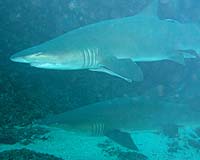
Bremen, Germany (SPX) Jul 18, 2005 Covering ship hulls with artificial shark skin could help ships sailing smoothly. The growth of marine organisms such as barnacles on ship hulls is a major cause of increased energy costs in the naval industry. Shark skin offers a structural design that prevents this so called 'bio-fouling'. Ralph Liedert from the University of Applied Sciences, Bremen, Germany, is presenting his work on the application of artificial shark skin in a new anti-fouling strategy at the Society for Experimental Biology Annual Main Meeting in Barcelona [session A7.66]. Shark skin comprises scales that can flex individually from each other. Liedert produced a synthetic shark skin of elastic silicone, which has a significantly decreased contact surface. This reduced contact surface makes it harder for barnacles to attach, and reduces fouling by 67%. When applied to the ship hull, this artificial surface enables ships to 'self-clean', and a speed of 4-5 knots would remove all organisms attached with little adhesion. Until recently, paints containing a biocide were used to prevent growth on submerged surfaces, but these were banned because of the the toxic effect of the highly toxic and unspecific biocide component on marine life. As barnacles, mussels and algae cause up to 15% increase in the drag resistence of ships, this research is providing an alternative anti-fouling strategy of great importance. Community Email This Article Comment On This Article Related Links Society for Experimental Biology SpaceDaily Search SpaceDaily Subscribe To SpaceDaily Express Space Technology News - Applications and Research
 NGC Chosen To Proceed With Developing Solid-State Laser Technology For Military Applications
 Redondo Beach CA (SPX) Jan 09, 2006
Northrop Grumman Corporation has been selected to develop "military-grade," solid-state laser technology that is expected to pave the way for the U.S. military to incorporate high-energy laser systems across all services, including ships, manned and unmanned aircraft, and ground vehicles. |
|
|

| The content herein, unless otherwise known to be public domain, are Copyright 1995-2006 - SpaceDaily.AFP and UPI Wire Stories are copyright Agence France-Presse and United Press International. ESA PortalReports are copyright European Space Agency. All NASA sourced material is public domain. Additionalcopyrights may apply in whole or part to other bona fide parties. Advertising does not imply endorsement,agreement or approval of any opinions, statements or information provided by SpaceDaily on any Web page published or hosted by SpaceDaily. Privacy Statement |