|
 |
 |
 |
 |
 |
 |
 |
 |

 |
Sharing Secrets Via Teleportation
Canberra (SPX) May 13, 2004 Spy networks and international financial systems are set to benefit from a significant advance in teleportation technology developed at The Australian National University. ANU researchers in Canberra have announced that they are the first in the world to demonstrate the sharing of secrets via teleportation using quantum physics. The research has potential to significantly enhance the security of computer systems around the world. The researchers provided a window on the future of telecommunications by demonstrating the production, disembodiment and successful reconstruction -- or teleportation -- of a message to a network of participants. The experiment was conducted by 24-year-old PhD student Andrew Lance and Dr Thomas Symul from the Quantum Optics Group in the ANU Faculty of Science, in collaboration with Professor Barry Sanders from the University of Calgary in Canada. The research, published in the latest edition of Physical Review Letters, is expected to attract attention from defence and finance industries around the world. It builds on the teleportation work conducted by Dr Warwick Bowen and Dr Ping Koy Lam at the ANU in 2002, when they teleported information using a laser beam. "This is a much more complex form of information teleportation in the sense that it involves multiple recipients," Dr Lam said. Acting ANU Vice-Chancellor Professor Lawrence Cram congratulated the team on their success. "This research confirms that ANU and Australia are among the World's leaders in teleportation research. It is also a fine example of the excellence achieved through The Australian National University's unique research-driven education program," Professor Cram said. The researchers used crystals, lenses and mirrors to produce a pair of 'entangled' laser beams that are then used to carry fragile information in the form of quantum states. These quantum states cannot be measured or copied, making eavesdropping impossible. The transmission of the light beams constitutes a secret communication scheme with guaranteed security. The process of secret sharing is a fundamental part of present day telecommunication, computer and banking practices. Such network communication can be enhanced using the laws of quantum physics to protect the information -- a process called quantum state sharing. "The benefit of this technology is that the encrypted message can only be decoded by a majority of recipients. For example, if an encrypted message was sent to a spy network containing 15 individuals, a minimum of eight agents would be needed to access the message -- limiting the chances of the message being infiltrated or deleted by a double-agent," Mr Lance said. "The system could also have major applications as a fail-safe mechanism in operating systems for the new generation of super-fast quantum computers." Barry Sanders, iCORE Professor and Director of the newly launched Institute for Quantum Information Science at the University of Calgary, said; "Security is crucial for quantum networks that may someday deliver ultrafast solutions to certain computational problems and for communication that is impervious to eavesdroppers. Our experiment demonstrates that quantum networks can be protected from component failures and malice." There is currently a huge concentration of scientific effort to use quantum physics -- a field in which researchers analyse the realms of the microscopic world where classical physics no longer applies -- in order to create a new generation of technologies including information teleportation. "Teleportation of information has potential to improve the efficiency and security of future quantum computing and communication networks," Dr Symul said. Community Email This Article Comment On This Article Related Links Australian National University SpaceDaily Search SpaceDaily Subscribe To SpaceDaily Express Nuclear Space Technology at Space-Travel.com
 Carina Nebula Dust Pillars Harbor Embedded Stars
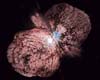 Boulder CO (SPX) May 31, 2005
Astronomers using NASA's Spitzer Space Telescope have imaged a giant molecular cloud being shredded by howling stellar winds and searing radiation, exposing a group of towering dust pillars harboring infant stars, according to a University of Colorado at Boulder researcher. |
|
|

| The content herein, unless otherwise known to be public domain, are Copyright 1995-2006 - SpaceDaily.AFP and UPI Wire Stories are copyright Agence France-Presse and United Press International. ESA PortalReports are copyright European Space Agency. All NASA sourced material is public domain. Additionalcopyrights may apply in whole or part to other bona fide parties. Advertising does not imply endorsement,agreement or approval of any opinions, statements or information provided by SpaceDaily on any Web page published or hosted by SpaceDaily. Privacy Statement |