|
 |
 |
 |
 |
 |
 |
 |
 |

 |
Shake And Bake For SMOS
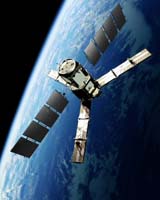
Netherlands (ESA) Jun 16, 2005 Development of the SMOS (Soil Moisture and Ocean Salinity) mission payload is currently completing a major milestone as the 'Structural Thermal Model' undergoes mechanical and thermal qualification at ESA-ESTEC in the Netherlands. This means that the payload is being thoroughly tested to ensure that it will withstand the environmental conditions encountered during launch and orbit. Not everything can be tested for at once. Therefore, the testing programme consists of a sequence of individual tests in which each environmental stress is simulated one by one. First up is the vibration test where the rattling of the launcher rocket is simulated at low frequency range. This is carried out on a 'shaker' where large electromagnetic actuators control the shaking of a special platform on which the payload model is mounted. About 150 accelerometers, which are placed at strategic positions within the model, record how it responds. The three principle axes are tested one by one, where some reconfiguration has to be performed between sessions. The next testing stage involves acoustic testing where the payload is exposed to the same incredible noise that will prevail under the fairing, i.e. under the nose cone of the rocket that protects the satellite as it is launched through the atmosphere into space. To undergo these tests the Structural Thermal Model is moved to the Acoustic Chamber, which is basically a large empty, but well insulated area, housing huge loudspeakers. This test is particularly critical for large flat components, such as the lateral panels and the top surface of the folded arms. Finally, the Structural Thermal Model is moved to the Large Space Simulator, where the arms will be deployed manually. The model will then be exposed to the same vacuum and temperature conditions as that of space. The temperature of space is simulated by liquid nitrogen cooled to -180� C, whilst solar radiation is simulated by a beam 6 metres in diameter generated by powerful lamps. During these tests the Structural Thermal Model will be equipped with some 200-temperature sensors to record its responses and compare them with software simulation. Most of the tests will be repeated on the actual flight model, although less rigorously, so to not overstress the flight hardware. All this testing marks a significant milestone in the development of the SMOS mission, which is due for launch in 2007. SMOS will provide high-resolution global maps of soil moisture and ocean salinity. Data on these two variables are urgently required to advance our knowledge of the Earth's water cycle and thus contribute to improving the forecasting of climate, weather and meteorological extremes. SMOS will also monitor the water content in vegetation, and provide observations over regions of ice and snow, contributing to the studies of the cryosphere. Community Email This Article Comment On This Article Related Links SMOS Earth Explorers SpaceDaily Search SpaceDaily Subscribe To SpaceDaily Express Climate Science News - Modeling, Mitigation Adaptation
 The Forgotten Methane Source
 Heidelberg, Germany (SPX) Jan 11, 2006
In the last few years, more and more research has focused on the biosphere; particularly, on how gases which influence the climate are exchanged between the biosphere and atmosphere. Researchers from the Max Planck Institute for Nuclear Physics have now carefully analysed which organic gases are emitted from plants. |
|
|

| The content herein, unless otherwise known to be public domain, are Copyright 1995-2006 - SpaceDaily.AFP and UPI Wire Stories are copyright Agence France-Presse and United Press International. ESA PortalReports are copyright European Space Agency. All NASA sourced material is public domain. Additionalcopyrights may apply in whole or part to other bona fide parties. Advertising does not imply endorsement,agreement or approval of any opinions, statements or information provided by SpaceDaily on any Web page published or hosted by SpaceDaily. Privacy Statement |