|
 |
 |
 |
 |
 |
 |
 |
 |

 |
Setting The Sino-U.S. Strategic Agenda
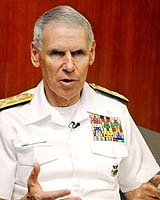
Beijing (UPI) Sep 08, 2005 Putting China on the radar screen of the Commander of the U.S. Pacific Command, Admiral William J. Fallon, was a positive step in Sino-U.S. ties this week. Admiral Fallon is the leader of all U.S. military forces in the Pacific and Indian Ocean, an expanse covering half the globe's total surface area stretching from California to the east coast of Africa. Approximately 300,000 personnel from the Army, Navy, Air Force, and Marine Corps are under his unified command with one-third of these assets stationed overseas in the Forward Deployed category. Mutual understanding of the strengths and weaknesses plus the opportunities and threats posed by the People's Liberation Army (the PLA acronym covers all of China's armed forces) is crucial for the security and prosperity not only of the two nations and the Asia-Pacific region, but the world at large. The admiral's trip, his first ever to China, comes six months into his current posting. It indicates a growing recognition within the American defense community that closer military-to-military connections with the mainland are essential to carrying out the stated mission, vision and several major focus area priorities within the U.S. Pacific Command. Fallon arrived Monday for a weeklong trip beginning in Beijing. After visiting Shanghai, the admiral will tour bases near Guangzhou, and then see Hong Kong to finish his itinerary. According to state-run Chinese media, the admiral was invited to China by Liu Zhenwu, commander of the Guangzhou Military Area Command. On Tuesday Fallon met with members of China's Central Military Commission Liang Guanglie, the PLA's Chief of the General Staff as well as Guo Boxiong, one of three vice-chairmen on the 11-man organization headed by president and party general secretary Hu Jintao. There are two CMCs: one provides links between the PLA and the ruling Communist Party; the other is between the military and civilian government. Analysts identify multiple key issues shaping the long term development of Sino-U.S. military ties: the nature of military cooperation between China and Russia; the effect of deteriorating Sino-Japanese relations on the U.S. Japan Mutual Defense Treaty; minimizing the possibility of Taiwan becoming a flashpoint, mollifying Chinese concerns about the U.S. intentions in Central Asia, and addressing America's concerns about the rise of China's military accompanying its growing economic power. In his opening remarks at a roundtable briefing with American and Chinese reporters Wednesday, Fallon told UPI and others he was here "trying to get the measure of the country and people, what's going on, what people are thinking." "One of the things I've been talking to the leaders about, and we've got prompt agreement on, is the need to have broader military to military contact. The military relationship has been lagging," the admiral noted. Fallon made the observation: "I think it's important that we address this issue because as the ties between the two countries deepen, it's important that we move forward on all fronts. There's a lot of concern on every aspect of the relationship; the more we can get together on military issues, the better off we're going to be." "As we meet with our counterparts here in Beijing, and visit other areas of China, the messages I am carrying are to increase our interactions, and work on transparency and reciprocity." The head of U.S. Pacific Command characterized these as "really critical" aspects of the relationship, saying: "If we're open with one another and share information and ideas, my experience is it reduces the anxiety, the fears of the unknown, and the suspicions that come from lack of knowledge -- we want to move forward in this area." Headquarters of Pacific Command states its mission as being, "in concert with other U.S. government agencies and regional military partners, promote security and peaceful development in the Asia-Pacific region by deterring aggression, advance regional security cooperation, respond to crises, and fight to win." A fact sheet given to the press said the organization's vision was, "A joint combatant command directing, integrating and employing ready, credible military capability in peace, crisis or war to advance U.S. interests as an active partner in pursuit of a secure, prosperous and democratic Asia-Pacific community." There are five major focus areas at U.S. Pacific Command: 1. Prosecute and win the Global War on Terrorism (GWOT); 2. Mature our joint and combined war fighting capability and readiness; 3. Ensure operational plans are credible; 4. Advance regional security cooperation; 5. Posture forces for agile and responsive employment. Concomitant to the mainland's rise as a commercial powerhouse has been greater efforts by the Chinese leadership to modernize its armed forces, stressing qualitative assets like reorganization and professional training as well as quantitative factors such as increased spending and decreased troop size. Admiral William Fallon's journey points to intensified efforts by the U.S. to put military-to-military ties on a basis capable of managing the mainland's ascent without the two countries coming to blows. Community Email This Article Comment On This Article Related Links SpaceDaily Search SpaceDaily Subscribe To SpaceDaily Express China News from SinoDaily.com
 China Wants To Expand Sino-US Military Relations
 Beijing (AFP) Jan 10, 2006
China is ready to expand its military relations with the United States, Chinese Defense Minister Cao Gangchuan said on Tuesday. |
|
|

| The content herein, unless otherwise known to be public domain, are Copyright 1995-2006 - SpaceDaily.AFP and UPI Wire Stories are copyright Agence France-Presse and United Press International. ESA PortalReports are copyright European Space Agency. All NASA sourced material is public domain. Additionalcopyrights may apply in whole or part to other bona fide parties. Advertising does not imply endorsement,agreement or approval of any opinions, statements or information provided by SpaceDaily on any Web page published or hosted by SpaceDaily. Privacy Statement |