|
 |
 |
 |
 |
 |
 |
 |
 |

 |
Senior Leaders Eye Robust Intelligence Capabilities And People
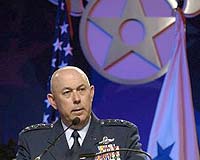
Washington DC (AFPN) Aug 22, 2006 Several active duty and retired senior leaders from the Air Force intelligence community gathered with Air Force Chief of Staff Gen. T. Michael Moseley at the Pentagon recently as part of an intelligence summit and strategy session. The leaders are reviewing how and when the Air Force uses intelligence products, people and resources, as well as developing a road map for the future of the career field. "In today's world of information, analysis, and kinetic and non-kinetic approaches to problems, I believe we can take a slightly different and a more aggressive look at our intelligence operation and those hard-working people who do this important job for us," General Moseley said. "The question we're addressing is: How can we make intel even better? How can we best take care of our intelligence folks and the mission they're charged with? This summit is an important step in that process." The summit comes after General Moseley named Lt. Gen. David A. Deptula as the Air Force's first deputy chief of staff for intelligence, elevating it to a three-star billet from its former two-star position. "Warfare is changing, and the intelligence career field is changing with it," General Deptula said. "We're moving into a new, interdependent world, and with the support we're getting from Air Force leadership, our people and processes will reflect that." In recent years, the Air Force intelligence community has resided inside the Directorate of Air and Space Operations, but with the implementation of the A-Staff last winter, intelligence gained its own designation as A-2, aligned directly under the chief of staff. General Moseley also noted that, with few exceptions, there is little "organic" intelligence representation in the general officer ranks. Currently, only four general officers are core intelligence officers. "Ultimately, I'd like for the Air Force to be able to grow more Mike Haydens," the chief of staff said, referring to Gen. Michael V. Hayden, the current director of the Central Intelligence Agency. "I'd like to ensure that, for years to come, we're able to contribute across all agency, departmental, branch of service, and joint and coalition lines." Regional expertise, languages skills, an operational focus, and joint experience are just some of the things officials are looking at capitalizing on to bring the career field to the next level, according to General Moseley. "Intel is a critical mission area, and we need to be sure we get this right," said General Moseley. "We've got to develop the right capabilities, and we've got to be sure that force development for our enlisted force, our civilians, and our officers is on the right vector." During the summit, the assembled leaders received briefings and reviewed discussion points on a myriad of subjects affecting the career field, including organization, process, and personnel, with a special emphasis on force development for officers and enlisted personnel. The summit was just the beginning of a challenging and exciting journey, said General Deptula. "The chief has given me 90 days to chart a way ahead for shaping Air Force intel to best contribute to meeting our nation's security needs," General Deptula said. "We are rapidly moving into an era where the demands on intel will be much greater than they have been in the past. Accordingly, we may need to adjust our structure, personnel policies, and ISR capabilities." The summit attendees will see the results of the study sometime in November, when the chief of staff will reconvene the summit, according to Lt. Gen. Arthur J. Lichte, director of the Air Staff at the Pentagon. Additionally, similar summits are planned for the near future, to include the topics of space, cyberspace and acquisition. "Air Force leaders are focused on ensuring we have the right capabilities now, and in the future, to fight the long war," said General Lichte. "We need to ensure we're prepared for any threat, and that's why there's a focus now on intelligence and space operations." General Moseley concurred. "I think in this world we're living in, we need to ensure our intelligence cadre are the best equipped, best trained operators they can be," General Moseley said. "We can give our intelligence NCOs and officers a more robust background, and be able to contribute across a much wider spectrum with our other warfighters and combatant commanders." "I have a great appreciation for the intelligence career field and what our people bring to the fight event day," General Moseley said. "I'm excited for this career field. It's time we open the aperture a bit and let our people shine." Community Email This Article Comment On This Article Related Links News and analysis about the Global War Against Terror at SpaceWar.com The Long War - Doctrine and Application
 83-year-old Canadian Sets OFf Radioactive Sensors At Border Crossing
 Washington (UPI) Aug 18, 2006
An 83-year-old Canadian man, who had received a radioactive dye for diagnosis of a heart condition, set off radiation detectors at the U.S.-Canadian border. The Vancouver Sun reported on Aug. 16 that border guards stopped 83-year-old Stanley Smith at the Peace Arch crossing on August 11. Smith wanted to visit a casino in Ferndale, Wash., but the dye set off alarms during a routine security screening. |
|
|

| The content herein, unless otherwise known to be public domain, are Copyright 1995-2006 - SpaceDaily.AFP and UPI Wire Stories are copyright Agence France-Presse and United Press International. ESA PortalReports are copyright European Space Agency. All NASA sourced material is public domain. Additionalcopyrights may apply in whole or part to other bona fide parties. Advertising does not imply endorsement,agreement or approval of any opinions, statements or information provided by SpaceDaily on any Web page published or hosted by SpaceDaily. Privacy Statement |