|
 |
 |
 |
 |
 |
 |
 |
 |

 |
Self-Powered Sensors To Watch Over Hydrogen Cars
New York (UPI) Jun 21, 2006 Nanotechnological, inexpensive sensors that can detect invisible, odorless hydrogen leaks and sound the alarm wirelessly could help safeguard future vehicles and refueling stations based on the gas, experts told UPI's Nano World. Intriguingly, the sensors have the ability to power themselves by harvesting energy from slight vibrations. This means they could operate continuously without batteries or maintenance when affixed to cars, refrigerators, pumps, motors or any other vibrating machine, the researchers added. The chemical reaction hydrogen cars run on is remarkably simple. Just combine hydrogen gas with oxygen and you get energy and water - and none of the dirty mix of toxins and global warming gases burning gasoline spews forth. The cleanliness of hydrogen is in large part why government and industry support for hydrogen vehicles has reached into the billions of dollars. The problem is hydrogen is odorless, invisible and potentially explosive. Researchers at the University of Florida at Gainesville funded by NASA have developed hydrogen sensors designed to work together in the dozens or hundreds to overcome this hurdle. "You will need to have sensors all over the place - if there is a leak, you can see which ones light up, and where the leak is, and how quickly it is spreading. That way you can shut off valves and avoid a major problem," said researcher Steve Pearton, a materials engineer. The sensors, currently the size of a deck of cards, employ rods of zinc oxide only nanometers or billionths of meters wide coated with platinum catalyst. Extremely tiny electrical currents are passed through each rod, and the more hydrogen surrounds these whiskers, the more conductive they become, to effectively detect hydrogen in the air. The researchers also developed wireless transmitters to broadcast signals out from the sensors, as well as ways to power the devices either through conventional solar cells or piezoelectric energy harvesters that convert vibrations into electricity. "You need lots of hydrogen sensors to detect leaks, but you don't want to have to maintain them or change the battery every couple of months," said researcher Jenshan Lin, an electrical engineer. "Our sensor can operate completely independently." Lab tests of the sensors revealed they could detect hydrogen concentrations as little as 10 parts per million - well below the level hydrogen becomes explosive - and transmit the information as far as 65 feet. The researchers next hope to further miniaturize the sensors. "This is a cool technology - you don't need to supply it any power," said George Chu, director of device development at optical networking company Multiplex in South Plainsfield, N.J. "And all these things could be designed onto a silicon chip that you could put anywhere." The researchers developed the sensor over the past two years as part of a National Aeronautics and Space Administration project to improve the safety and reliability of all of the space agency's hydrogen systems, including the liquid hydrogen-fueled space shuttle. They will present their findings at an American Society of Mechanical Engineers conference in Chicago in November, providing more details about the self-powering aspect of the sensors, Pearton said. The researchers will conduct more field tests later this summer to establish the reliability of the system, he added. "This is a very good proof of concept, a demonstration of principle of what this type of sensor technology can achieve. It won't be on the market next week, but it does give a good example of how nanotechnology can be combined with digital electronics to make smart systems," said Gary Hunter, a senior electronics engineer at NASA Glenn Research Center in Cleveland. "A significant amount of work needs to be done. This has just scratched the surface of this kind of technology."
Source: United Press International Community Email This Article Comment On This Article Related Links American Society of Mechanical Engineers Car Technology at SpaceMart.com
 Activists Press Ford On Environmental Policies
 Detroit, Michigan (AFP) May 10, 2006
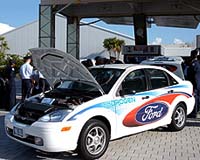
Activists plan to use the Ford Motor Company's annual shareholder meeting this week to press the company for changes in its environmental policies and practices. |
|
|

| The content herein, unless otherwise known to be public domain, are Copyright 1995-2006 - SpaceDaily.AFP and UPI Wire Stories are copyright Agence France-Presse and United Press International. ESA PortalReports are copyright European Space Agency. All NASA sourced material is public domain. Additionalcopyrights may apply in whole or part to other bona fide parties. Advertising does not imply endorsement,agreement or approval of any opinions, statements or information provided by SpaceDaily on any Web page published or hosted by SpaceDaily. Privacy Statement |