|
 |
 |
 |
 |
 |
 |
 |
 |

 |
Seeing Red
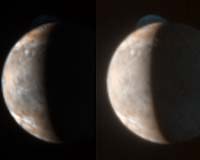
Laurel MD (SPX) Feb 29, 2008 This New Horizons image of Jupiter's volcanic moon Io was taken at 13:05 Universal Time during the spacecraft's Jupiter flyby on February 28, 2007. It shows the reddish color of the deposits from the giant volcanic eruption at the volcano Tvashtar, near the top of the sunlit crescent, as well as the bluish plume itself and the orange glow of the hot lava at its source. The relatively unprocessed image on the left provides the best view of the volcanic glow and the plume deposits, while the version on the right has been brightened to show the much fainter plume, and the Jupiter-lit night side of Io. New Horizons' color imaging of Io's sunlit side was generally overexposed because the spacecraft's color camera, the super-sensitive Multispectral Visible Imaging Camera (MVIC), was designed for the much dimmer illumination at Pluto. However, two of MVIC's four color filters, the blue and "methane" filter (a special filter designed to map methane frost on the surface of Pluto at an infrared wavelength of 0.89 microns), are less sensitive than the others, and thus obtained some well-exposed views of the surface when illumination conditions were favorable. Because only two color filters are used, rather than the usual three, and because one filter uses infrared light, the color is only a rough approximation to what the human eye would see. The red color of the Tvashtar plume fallout is typical of Io's largest volcanic plumes, including the previous eruption of Tvashtar seen by the Galileo and Cassini spacecraft in 2000, and the long-lived Pele plume on the opposite side of Io. The color likely results from the creation of reddish three-atom and four-atom sulfur molecules (S3 and S4) from plume gases rich in two-atom sulfur molecules (S2 After a few months or years, the S3 and S4 molecules recombine into the more stable and familiar yellowish form of sulfur consisting of eight-atom molecules (S8), so these red deposits are only seen around recently-active Io volcanos. Though the plume deposits are red, the plume itself is blue, because it is composed of very tiny particles that preferentially scatter blue light, like smoke. Also faintly visible in the left image is the pale-colored Prometheus plume, almost on the edge of the disk on the equator at the 9 o'clock position. Io was 2.4 million kilometers from the spacecraft when the picture was taken, and the center of Io's disk is at 77 degrees West longitude, 5 degrees South latitude. The solar phase angle was 107 degrees. Community Email This Article Comment On This Article Related Links Jupiter and its Moons Explore The Ring World of Saturn and her moons The million outer planets of a star called Sol News Flash at Mercury
 Russia to search for life on Jupiter's moon Europa: report
 Moscow (AFP) Jan 7, 2008
Russia plans to participate in a European mission to investigate Jupiter's moon Europa and search for simple life forms, the Interfax news agency reported on Monday, quoting a senior researcher. |
|
|

| The content herein, unless otherwise known to be public domain, are Copyright 1995-2007 - SpaceDaily.AFP and UPI Wire Stories are copyright Agence France-Presse and United Press International. ESA Portal Reports are copyright European Space Agency. All NASA sourced material is public domain. Additional copyrights may apply in whole or part to other bona fide parties. Advertising does not imply endorsement,agreement or approval of any opinions, statements or information provided by SpaceDaily on any Web page published or hosted by SpaceDaily. Privacy Statement |